
A deep dive into carbon dioxide’s commercial potential – from food-grade CO₂ to carbon capture – by a CO₂ industry expert
Introduction: CO₂ Is Not Just a Greenhouse Gas
When most people hear “carbon dioxide,” they think of climate change, vehicle exhaust, or the fizz in their soft drinks. But as someone who has spent years working within India’s industrial gas ecosystem, I can tell you that CO₂ – particularly in its liquid form – is one of the most versatile, economically critical, and strategically underutilized industrial commodities in the country today.
Liquid Carbon Dioxide (liquid CO₂) is a colorless, odorless substance produced by compressing gaseous CO₂ under specific temperature and pressure conditions. At standard conditions, CO₂ exists as a gas; however, when pressurized above 5.1 atmospheres and cooled below −56.6°C, it transitions into a liquid state with extraordinary industrial utility.
The global liquid CO₂ market was valued at over USD 8.5 billion in 2023 and is projected to cross USD 13 billion by 2030. India, as a rapidly industrializing economy, represents one of the fastest-growing demand centers for liquid CO₂ and yet, we are still at the beginning of unlocking its full potential.
This blog is written for engineers, industry professionals, procurement teams, policy makers, and anyone curious about the science and commerce of CO₂ in India. Let us explore what liquid CO₂ is, how it is produced, what it is used for, and why its future in India is nothing short of transformational.
What Is Liquid CO₂? Understanding the Science
CO₂ exists in four phases depending on temperature and pressure: solid (dry ice), liquid, gas, and supercritical fluid.
Liquid CO₂ occupies the narrow but commercially vital sweet spot between gas and supercritical states. Stored in pressurized vessels (typically at around 20–25 bar and −18°C to 0°C), liquid CO₂ is easy to transport, store, and dose with precision making it ideal for industrial, food, and medical applications.
Key properties of liquid CO₂:
- Molecular weight: 44.01 g/mol
- Density (liquid at 20°C): ~770 kg/m³
- Boiling point: −78.5°C (sublimation at 1 atm)
- Critical temperature: 31.1°C
- Critical pressure: 73.8 bar
When liquid CO₂ is released from pressure, it rapidly expands and cools a property exploited in fire suppression, food freezing, and industrial cooling systems.
How Is Liquid CO₂ Produced in India?
India’s liquid CO₂ supply chain primarily draws from three sources:
1. By-product capture from fertilizer and ammonia plants The largest domestic source. Fertilizer plants in states like Uttar Pradesh, Gujarat, Rajasthan, and Odisha produce CO₂ as a by-product of hydrogen generation via steam methane reforming. This CO₂, after purification, becomes food-grade or industrial-grade liquid CO₂.
2. Recovery from refineries and petrochemical plants Refineries emit significant volumes of CO₂ that can be captured, purified, liquefied, and distributed. IOCL, BPCL, and HPCL plants are increasingly under pressure to monetize rather than vent this CO₂.
3. Fermentation-based CO₂ Breweries, distilleries, and ethanol plants generate high-purity CO₂ as a by-product of fermentation. With India’s ethanol blending program scaling aggressively toward the E20 target, this segment is set to become a major domestic CO₂ supply source.
CO₂ is typically stored and transported in:
- ISO tanks for bulk liquid transport
- Cryogenic tankers for long-distance interstate movement
- Cylinders (high-pressure CO₂ cylinders) for commercial and laboratory use
Major Applications of Liquid CO₂ in India
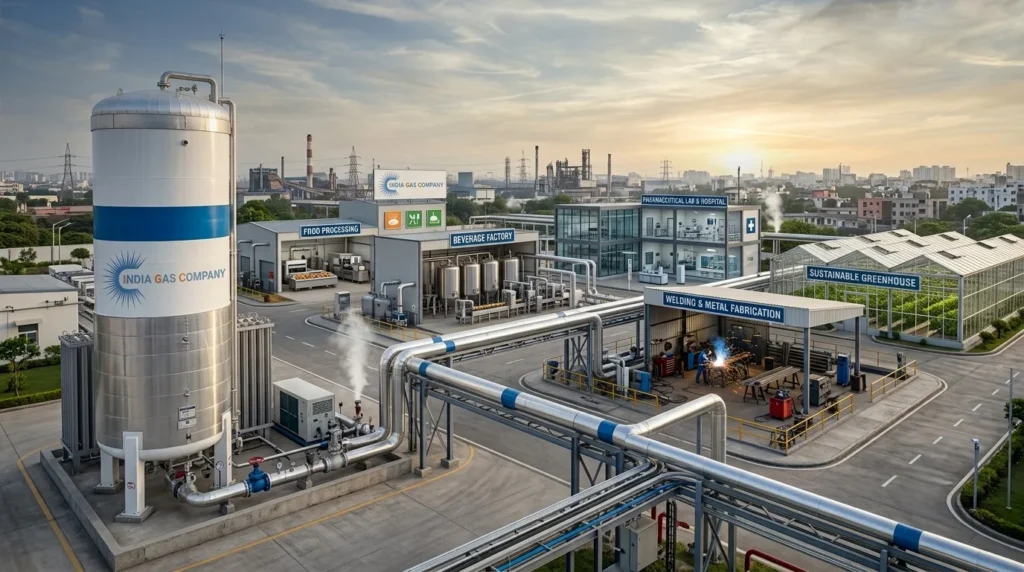
1. Food and Beverage Industry: Food Grade CO₂
This is perhaps the most well-known use of liquid CO₂ in India, and it is growing at an extraordinary rate.
Carbonation of beverages: Every bottle of Coca-Cola, Pepsi, Bisleri Spyci, and every glass of draught beer contains dissolved CO₂. Liquid CO₂ is injected under controlled pressure to carbonate soft drinks, sparkling water, and beers. India’s beverage market, growing at over 12% CAGR, is a massive consumer of food-grade CO₂.
Modified Atmosphere Packaging (MAP): This technology uses a blend of CO₂, nitrogen, and oxygen to extend the shelf life of packaged foods from bakery products and meats to fresh salads. As organized retail and e-grocery platforms expand in India, MAP is witnessing explosive adoption.
Food Freezing and Chilling: Liquid CO₂ is used in cryogenic food freezing tunnels where it rapidly cools meat, seafood, poultry, and processed foods without quality degradation. CO₂ snow systems where liquid CO₂ is converted to snow-form are used for in-transit cooling of temperature-sensitive foods.
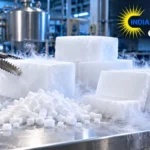
Dry Ice Production: Solid CO₂ (dry ice) is made from liquid CO₂ and is critical for pharmaceutical cold chain logistics, vaccine transport (especially post-COVID awareness), and frozen food exports. Demand for dry ice in India has surged dramatically since 2021.
2. Healthcare and Medical Applications
Medical-grade CO₂ is a pure form used across multiple clinical and therapeutic settings:
- Laparoscopic surgery: CO₂ is the gold standard insufflation gas used to inflate the abdominal cavity during minimally invasive surgeries. Every laparoscopy, colonoscopy, and robotic surgery procedure uses medical CO₂.
- Cryotherapy: Liquid CO₂ and CO₂ snow are used in dermatology for removing warts, lesions, and skin tags.
- CO₂ laser surgery: CO₂ lasers are among the most common surgical lasers used for skin resurfacing, ENT procedures, and gynecological surgeries.
- Respiratory stimulation: CO₂ is added to oxygen in certain resuscitation protocols to stimulate breathing.
As India’s healthcare infrastructure expands with government schemes like Ayushman Bharat and the rapid growth of tier-2 hospital networks demand for medical-grade CO₂ will grow significantly.
3. Industrial Applications of CO₂
Metal welding and fabrication: CO₂ is a widely used shielding gas in MIG (Metal Inert Gas) welding, where it protects the weld pool from atmospheric contamination. India’s infrastructure boom in roads, railways, metro rail, and defence manufacturing is creating massive demand for welding-grade CO₂.
pH control and water treatment: Liquid CO₂ is injected into municipal water treatment facilities to control the pH of drinking water, replacing hazardous acids like sulfuric acid. This is a safer, cleaner alternative that is gaining traction in smart city water projects across India.
Fire suppression systems: CO₂ fire suppression is the preferred technology for data centers, server rooms, electrical substations, museums, and marine vessels. As India’s data center industry grows (expected to reach USD 10 billion by 2027), CO₂ fire suppression systems will see accelerated uptake.
Rubber and plastic manufacturing: CO₂ is used in chemical processes including polycarbonate synthesis and polyurethane foaming. India’s packaging and automobile component industries are significant consumers.
Electronics and semiconductor cleaning: Ultra-pure CO₂ is used in semiconductor fabrication for cleaning and supercritical fluid extraction processes.
4. Agriculture CO₂ in Controlled Environment Agriculture
This is an emerging but enormously exciting application in the Indian context.
Greenhouse CO₂ enrichment: Plants fix CO₂ through photosynthesis. In enclosed greenhouse environments tomato, capsicum, cucumber, and flower farms injecting elevated CO₂ (typically 800–1200 ppm versus the ambient 420 ppm) can boost yields by 20–40%. India’s horticulture export ambitions make this application increasingly important.
Post-harvest fumigation: CO₂-based fumigation is being explored as an alternative to methyl bromide and chemical pesticides for grain storage, a particularly relevant application given India’s massive foodgrain production.
5. CO₂ in Enhanced Oil Recovery (EOR)
CO₂ injection into oil reservoirs improves the mobility of crude oil and enhances recovery rates a process called CO₂-EOR. ONGC and Oil India Limited are evaluating CO₂-EOR pilots, particularly in mature fields like Gandhar in Gujarat. This creates a dual benefit: CO₂ is permanently stored underground while more oil is recovered a natural intersection of commercial interest and carbon management.
6. Supercritical CO₂: The Frontier Technology
Supercritical CO₂ (sCO₂) is CO₂ maintained above its critical temperature (31.1°C) and critical pressure (73.8 bar). In this state, it exhibits properties of both a liquid and a gas incredibly low viscosity but liquid-like density making it a remarkable solvent.
Applications include:
- Coffee and tea decaffeination (Nescafé, Tata Coffee)
- Hop extraction for craft brewing
- Nutraceutical extraction: extracting omega-3s, curcumin, and essential oils without chemical solvents
- Pharmaceutical API extraction
- Dry cleaning as an alternative to perchloroethylene
The nutraceuticals and herbal extract market in India driven by brands like Himalaya, Dabur, and Patanjali is a compelling growth avenue for supercritical CO₂ extraction technology.
The CO₂ Supply Crunch: A Crisis India Must Solve
In 2022, India experienced a sharp CO₂ shortage, particularly impacting the beverage and food processing industries. The reasons were structural:
- Most CO₂ production is co-located with fertilizer and ammonia plants that shut seasonally or for maintenance.
- Limited gas pipeline infrastructure means CO₂ must be transported as liquid in cryogenic tankers expensive and time-consuming.
- Low domestic CO₂ recovery capacity versus demand.
This supply-demand mismatch is a call to action for Indian industry. Investment in dedicated CO₂ capture and liquefaction infrastructure is not an option — it is a strategic necessity.
Carbon Capture, Utilization, and Storage (CCUS): The Future of CO₂ in India
Here is where the story of liquid CO₂ in India becomes genuinely historic.
India is the world’s third-largest emitter of CO₂, with annual emissions of approximately 2.8 billion tonnes. Under its Nationally Determined Contributions (NDCs) submitted to the UNFCCC, India has committed to achieving net zero by 2070 a commitment that makes CCUS not just relevant but essential.
Carbon Capture and Storage (CCS): Large point-source emitters power plants, cement factories, steel mills can capture CO₂ from their flue gases, compress it into a supercritical state, and inject it into deep geological formations for permanent storage.
India’s geological surveys indicate potential CO₂ storage capacity in the Deccan Traps, offshore sedimentary basins, and depleted oil & gas reservoirs.
Carbon Capture and Utilization (CCU): Rather than storing CO₂, it can be converted into useful products:
- Synthetic methanol (e-methanol) for shipping fuel
- E-fuels via the Fischer-Tropsch process
- Building materials — CO₂ is being used to cure and mineralize concrete, improving strength and permanently sequestering carbon
- Algae cultivation — industrial-scale microalgae farms use CO₂ as a feedstock to produce biofuels, animal feed, and high-value nutraceuticals
The Indian government, through NITI Aayog, has identified CCUS as a critical decarbonization pathway. The Ministry of Petroleum and Natural Gas has issued policy papers on CO₂ utilization, and ONGC has initiated CCUS pilot studies.
Market Opportunity: India’s Liquid CO₂ Industry by Numbers
| Segment | Current Market Size (India) | Projected CAGR (2024–2030) |
| Food & Beverage CO₂ | ₹ 1,800 Cr | 14% |
| Industrial CO₂ | ₹ 2,200 Cr | 11% |
| Medical CO₂ | ₹ 600 Cr | 16% |
| Dry Ice | ₹ 450 Cr | 22% |
| Supercritical CO₂ | ₹ 200 Cr | 28% |
| CCUS (nascent) | ₹ 50 Cr | 45%+ |
Regulatory Landscape: CO₂ Standards in India
- Food-grade CO₂ is regulated under the Food Safety and Standards Authority of India (FSSAI) and must conform to IS 307 standards.
- Medical CO₂ requires compliance with IP (Indian Pharmacopoeia) standards and licensing from the Central Drugs Standard Control Organization (CDSCO).
- Industrial CO₂ cylinders are governed by the Gas Cylinder Rules under the Petroleum and Explosives Safety Organization (PESO).
- The Bureau of Indian Standards (BIS) has published IS 307 for liquid CO₂ and IS 6654 for dry ice.
A robust regulatory framework for CO₂ carbon credits, geological storage, and CCUS monitoring is still developing and will be critical for India’s climate commitments.
Challenges Facing India’s CO₂ Industry
1. Infrastructure gaps: India lacks dedicated CO₂ pipelines. All bulk movement relies on road tankers, creating supply chain fragility and high logistics costs.
2. Purity and quality assurance: Adulteration and inadequate purification remain concerns, especially in the food and medical segments. Robust third-party testing infrastructure is needed.
3. Price volatility: CO₂ pricing in India is opaque and subject to sharp fluctuations linked to fertilizer plant turnarounds.
4. Awareness deficit: Many Indian industries, particularly SMEs in food processing, agriculture, and healthcare are unaware of the economic and quality benefits liquid CO₂ can deliver.
5. Green CO₂ at scale: To align with net-zero goals, India must develop Green CO₂ captured from biogenic or atmospheric sources rather than fossil fuel processes.
The Expert Perspective: Why CO₂ Deserves a Seat at India’s Industrial Strategy Table
India is spending trillions on infrastructure, manufacturing, healthcare, and agriculture. Every one of these sectors interacts with CO₂ as a utility, as a raw material, or as an emission to be managed. And yet, CO₂ as an industrial commodity remains fragmented, undersupplied, and undervalued in national industrial planning.
The countries that master the CO₂ value chain from capture to purification to utilization will have a decisive competitive advantage in the coming decade. Norway has built an entire CO₂ export strategy. The USA is deploying billions in CCUS under the Inflation Reduction Act. Singapore is developing CO₂ import terminals.
India must do the same. This means:
- National CO₂ supply infrastructure with dedicated pipelines and strategic storage hubs.
- Carbon credit frameworks that reward CO₂ capture and utilization.
- Incentivization of CO₂ technology in nutraceuticals, pharmaceuticals, and food processing.
- CCUS mandates for heavy industries steel, cement, power above threshold emission levels.
- Green CO₂ corridors linking bioenergy plants with food processing clusters.
Conclusion: India’s CO₂ Moment Has Arrived
Liquid CO₂ is not a niche industrial gas. It is a strategic commodity that touches food security, healthcare, manufacturing, energy, and climate. For a nation of 1.4 billion people pursuing simultaneous goals of economic growth and environmental sustainability, CO₂ is arguably the molecule of the decade.
As an industry expert, my message is clear: India must stop treating CO₂ as a waste gas and start treating it as the high-value resource it is.
The infrastructure investments, the regulatory frameworks, the industrial awareness, and the technology ecosystem for India’s CO₂ revolution are all within reach. The window is open. The opportunity is enormous.
The question is whether Indian industry, government, and investors will act before the rest of the world leaves us behind.
You May Like:
🔗 Why CO2 Plant Setup Is a Must for All Distilleries and Ethanol Plants?