
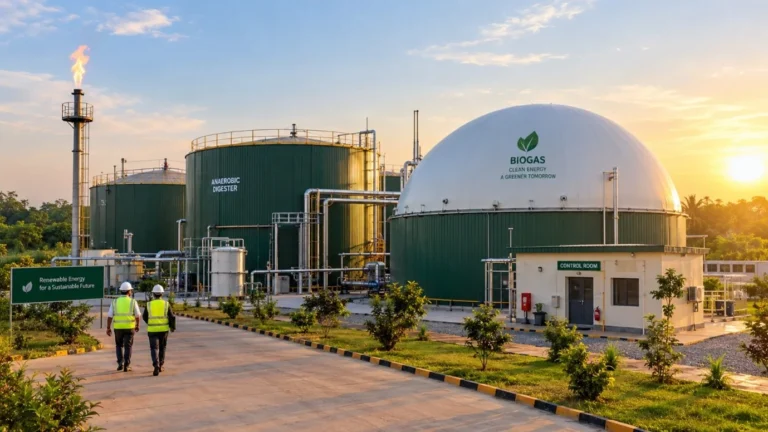

India generates a very large volume of organic waste every day. It comes from dairy farms, food plants, distilleries, hotels, sugar mills, markets and municipal bodies. For many businesses this waste is a disposal cost, a compliance headache and a source of methane emissions. With the right biogas technology, it can become a steady source of heat, power or upgraded fuel.
That is why more industries are now looking for the top biogas manufacturer in India. The technology is not new, but a biogas project is a long-term investment that depends heavily on engineering quality.
A plant that is poorly sized, badly matched to its feedstock or weakly commissioned will disappoint, however good the equipment looks on paper. Many buyers also find that a single Biogas EPC Contractor, responsible for engineering, procurement and construction, reduces project risk far more than assembling multiple vendors.
This guide is written for decision-makers who are planning or comparing biogas projects. It explains how biogas plants work, which technologies and feedstocks suit which applications, what drives cost, how to shortlist a manufacturer, and what to ask before you sign a contract.
What is a Biogas Plant?
A biogas plant is an engineered facility that treats biodegradable waste in the absence of oxygen and captures the gas released during the process. The biological process is called anaerobic digestion. Microorganisms break down organic matter inside a sealed digester and produce a gas mixture known as biogas.
Raw biogas is mainly made up of:
- Methane (CH₄): the combustible component, usually around half to two-thirds of the gas depending on feedstock and process conditions.
- Carbon dioxide (CO₂): the second major component, which reduces the calorific value of the gas.
- Trace gases: hydrogen sulphide (H₂S), water vapour, and small amounts of other compounds that must be managed to protect equipment.
The other output is digestate, the stabilised material left after digestion. It contains nutrients and organic matter and, when properly handled and subject to applicable standards, can be used as a soil amendment or processed further.
Anaerobic digestion happens in four broad biological stages:
- Hydrolysis: complex organic matter (carbohydrates, proteins, fats) is broken into simpler soluble compounds.
- Acidogenesis: these compounds are converted into volatile fatty acids, alcohols and gases.
- Acetogenesis: the acids are converted mainly into acetic acid, hydrogen and CO₂.
- Methanogenesis: methane-forming microorganisms convert these products into methane and CO₂.
The stages depend on each other. If one slows down, for example because of overloading or a temperature swing, the whole system is affected. This is why good process design matters as much as good equipment.
How Does a Biogas Plant Work?
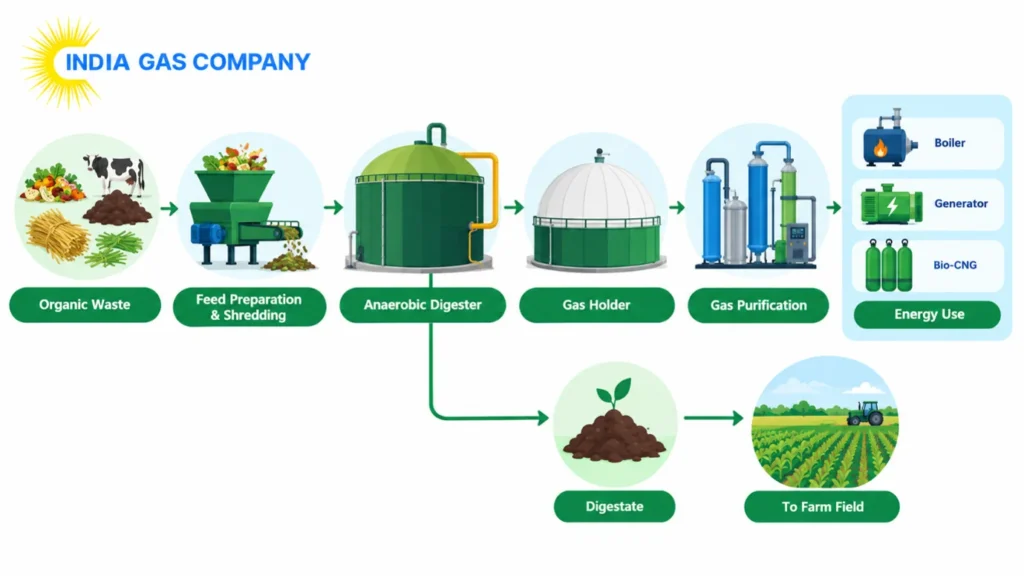
Every biogas plant is designed around its feedstock, but a typical industrial or commercial plant follows this sequence.
1. Feedstock collection. Waste is received from its source, such as dairy sheds, kitchens, process lines or collection vehicles. Consistent quantity and quality are important, so receiving arrangements are planned carefully.
2. Segregation and preparation. Non-biodegradable material such as plastic, metal, stones and packaging is removed. Depending on the feedstock, the waste may be shredded, crushed, screened, blended or diluted to reach the required consistency.
3. Feeding into the digester. Prepared feedstock goes to a buffer or feed tank and is pumped or conveyed into the digester at a controlled rate.
4. Anaerobic digestion. Inside the digester, temperature, mixing and organic loading are controlled so that the microbial community stays stable and active.
5. Biogas generation. As digestion proceeds, biogas rises and collects in the headspace of the digester or in a separate gas holder.
6. Gas collection and storage. The gas is collected through piping and held in a gas holder, which balances the difference between gas production and gas consumption.
7. Purification or upgrading. For most applications, H₂S and moisture must be removed. For Bio-CNG/CBG, CO₂ is also removed to raise the methane content.
8. Energy utilisation. The gas is used in boilers or burners, in a gas engine for power (often with heat recovery), or upgraded, compressed and dispensed as fuel. Any surplus is sent to a flare for safe disposal.
9. Digestate management. The digestate is stored, separated into solid and liquid fractions if required, and used or treated according to site plans and applicable norms.
A simple process flow:
Feedstock → Segregation and preparation → Feed tank → Digester → Gas holder → Purification/upgrading → Energy use (heat, power or Bio-CNG) → Digestate handling
Why Choose a Professional Biogas Manufacturer in India?
Biogas equipment is easy to compare on price and hard to compare on performance. That is why a low quotation can turn into an expensive project.
A professional biogas plant manufacturer in India brings much more than tanks and pumps. Consider what sits behind a working plant:
- Engineering expertise: turning a waste stream into a stable, well-sized process.
- Feedstock analysis: understanding moisture, solids, organic content and contaminants before designing anything.
- Plant sizing: matching digester volume, retention time and gas storage to real feedstock availability.
- Process design: choosing the right digester type, mixing, heating and feeding strategy.
- Equipment selection: pumps, agitators, gas systems and controls that suit the duty, not just the budget.
- Safety considerations: biogas is flammable and H₂S is toxic, so gas safety, ventilation, pressure relief and flare systems must be designed in from the start.
- Project execution, installation and commissioning: coordination on site is where many projects succeed or fail.
- Performance monitoring and maintenance: helping the plant stay stable after handover.
- Spare parts and technical support: so a minor equipment failure does not become weeks of downtime.
A plant is judged over years of operation, not on the day of inauguration. The top biogas manufacturer in India for your project is the one whose engineering, execution record and support capability match your needs and can be verified. The lowest price is rarely the right test.
What Does a Biogas EPC Contractor Do?
EPC stands for Engineering, Procurement and Construction. A Biogas EPC Contractor takes responsibility for delivering a working plant, from design through commissioning, under a defined scope, schedule and performance basis.
Here is what that covers.
Engineering
- Site assessment and layout planning
- Feedstock assessment and characterisation
- Process design and plant capacity calculation
- Equipment sizing
- Piping and instrumentation design
- Electrical design
- Instrumentation and control philosophy
- Safety planning, including hazardous area considerations
- General arrangement and layout development
Procurement
- Digesters and gas holders
- Feed pumps and agitators
- Gas cleaning systems, including H₂S removal and moisture removal
- Compressors
- Biogas upgrading systems where Bio-CNG/CBG is planned
- CHP (combined heat and power) systems
- Flare systems
- Control panels and automation systems
- Supporting equipment such as heat exchangers, valves and instruments
Construction
- Civil works, including foundations, tanks and feed areas
- Mechanical installation
- Electrical installation
- Piping and equipment installation
- Testing, including leak and pressure tests
- Commissioning and stabilisation
Why a single EPC partner simplifies things?
When engineering, supply and construction are split among different vendors, responsibility gets blurred. If gas quality is poor or an agitator does not suit the digester, each party can point to another. A single biogas plant manufacturer and EPC contractor is accountable for how the system performs as a whole. That means fewer interface problems, one point of contact and a clearer path to resolving issues.
Types of Biogas Plants Available in India
Different applications need different configurations. The table below summarises common types. Actual sizes and designs depend on site-specific assessment.
| Plant type | Suitable feedstock | Typical users | Key advantages | Design considerations |
| Industrial biogas plant | Process effluents, organic industrial waste | Manufacturing, agro and food industries | On-site waste treatment and energy recovery | Feedstock variability, effluent characteristics, integration with plant utilities |
| Commercial biogas plant | Kitchen and food waste | Hotels, restaurants, canteens, malls | Compact waste processing, cooking gas or heat use | Space, odour control, contamination in food waste |
| Dairy biogas plant | Cattle dung, dairy washings | Dairy farms, cooperatives, dairy processors | Steady, well-understood feedstock | Solids content, bedding material, digestate handling |
| Food waste biogas plant | Cooked and raw food waste, vegetable and fruit waste | Food processors, markets, institutions | High biodegradability | Pre-treatment, removing packaging, acidification risk |
| Agricultural waste biogas plant | Crop residues, farm waste, manure | Farms, agri-businesses | Uses locally available biomass | Seasonal supply, size reduction, lignocellulose content |
| Sewage/sludge-based plant | Sewage sludge, STP sludge | Municipal bodies, large institutions | Sludge stabilisation and energy recovery | Pathogen control, regulatory norms, dewatering |
| Distillery-based plant | Spent wash and related effluents | Distilleries | Treats high-strength effluent while recovering energy | High COD, sulphate content, H₂S management |
| Municipal organic waste plant | Segregated organic fraction of municipal solid waste | Municipal bodies, waste management firms | Diverts organic waste from landfill | Quality of segregation, contamination, logistics |
| High-capacity industrial plant | Large, consistent organic streams | Large industries, developers | Economies of scale, options for Bio-CNG | Detailed engineering, gas handling, statutory approvals |
Two points are worth stressing. First, feedstock quality and supply consistency matter more than plant size. Second, contamination is one of the most underestimated risks, particularly in food waste and municipal waste. A well-designed pre-treatment section often makes the difference between a plant that runs steadily and one that struggles.
Common Feedstocks Used for Biogas Production
Almost any biodegradable material can produce biogas, but each behaves differently in a digester.
- Cattle dung: widely available, stable and forgiving, with moderate gas yield per tonne.
- Food waste: highly biodegradable and energy-rich, but prone to souring and contamination.
- Vegetable and fruit waste: quick to digest, high moisture, and can acidify the digester if fed too fast.
- Agricultural residues: useful but often fibrous, so size reduction and longer retention may be needed.
- Dairy waste: whey and washings can be treated effectively, though fat and protein content needs management.
- Poultry waste: high nitrogen content can lead to ammonia inhibition if not balanced properly.
- Distillery waste: high-strength organic effluent with high sulphate content, requiring robust H₂S control.
- Industrial organic waste: includes waste from food, pharmaceutical and chemical processes, each requiring case-specific evaluation.
- Sewage sludge: stabilised through digestion, with dewatering and pathogen considerations.
- Other biodegradable waste: such as slaughterhouse waste or press mud, which need feedstock-specific study.
Why feedstock characteristics drive design
Feedstock properties affect nearly every design decision:
- Total solids and moisture decide whether a wet or dry-type system suits, and how the material is pumped or fed.
- Volatile solids indicate how much of the material can actually be converted into gas.
- Carbon-to-nitrogen balance affects microbial health and the risk of inhibition.
- Contaminants such as plastic, sand, oils and chemicals affect pumps, mixing and stability.
- Seasonal and daily variation determines whether buffer storage or co-digestion is needed.
This is why serious manufacturers begin with feedstock analysis rather than a catalogue.
Biogas Plant Technologies and Systems
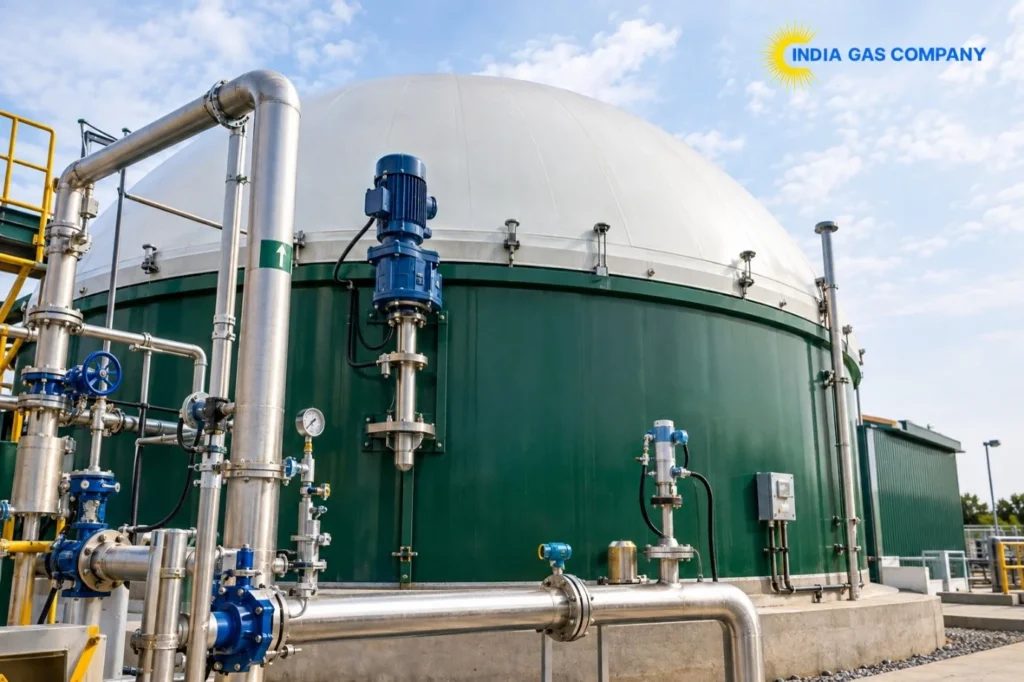
The right technology depends on feedstock, scale, site conditions, how the gas will be used and project objectives. Here are the main components.
Anaerobic digesters. The core of the plant. Designs differ by material, mixing method and feedstock suitability.
CSTR (continuously stirred tank reactor) systems. Widely used for wet feedstocks. Mechanical mixing keeps the digester contents uniform and helps stable gas production.
Plug-flow systems. Suitable in some cases for higher-solids feedstocks, where material moves through the digester in a plug-like manner.
Gas holders. Store biogas to balance production and consumption. Designs include membrane and other types, and the choice depends on the site and gas use.
Feed preparation systems. Include receiving hoppers, shredders, screens, grinders, mixing tanks and impurity removal.
Mixing systems. Agitators or other mixing arrangements keep the digester homogeneous, avoid dead zones and reduce scum and sediment.
Heating systems. Most industrial digesters operate in a controlled temperature range (commonly mesophilic or thermophilic). Heating, often using recovered heat, keeps the process stable.
Desulphurisation. Removes H₂S, which is corrosive and toxic. Methods include biological and chemical approaches.
Moisture removal. Cooling and condensate management protect downstream equipment.
Gas filtration. Removes particulates and other impurities.
Biogas upgrading. Removes CO₂ (and remaining impurities) to produce biomethane. Different technologies exist, and selection depends on scale, energy use and operating preferences.
Biogas compression. Raises pressure for engines, pipelines or storage as compressed Bio-CNG.
CHP systems. Generate electricity and recover heat from the same gas.
Gas flaring. A safety necessity. It burns surplus or off-spec gas in a controlled way.
Digestate handling. Includes storage, solid-liquid separation, drying or composting depending on the plan.
Automation and monitoring. Sensors, PLC-based controls and remote monitoring help operators track temperature, pH, gas flow and equipment status, and respond early to problems.
A well-integrated system matters more than any single component. Even good equipment can underperform if it is not designed to work as a whole.
Biogas to Bio-CNG: An Important Opportunity for Indian Industries
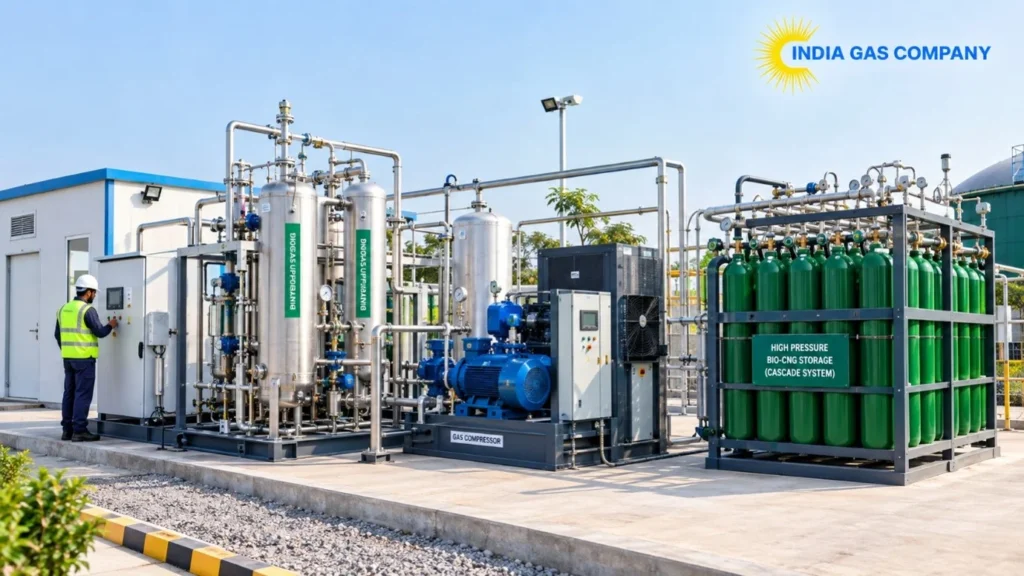
Bio-CNG, also referred to as compressed biogas (CBG), is biogas that has been purified and upgraded to a quality comparable to natural gas, then compressed for storage and use.
Conventional Biogas versus Upgraded Biomethane
| Aspect | Raw Biogas | Upgraded Biomethane / Bio-CNG |
| Methane content | Moderate | High (upgraded) |
| CO₂ content | Significant | Largely removed |
| Typical use | Boilers, burners, gas engines, cooking | Vehicle fuel, industrial fuel, grid or cascade supply |
| Treatment required | Basic cleaning | Advanced cleaning, CO₂ removal, compression |
| Project complexity | Lower | Higher |
How upgrading works
- H₂S removal protects equipment from corrosion.
- Moisture removal avoids condensation and downstream issues.
- CO₂ removal raises the methane concentration.
- Compression prepares the gas for storage, transport or dispensing.
Potential Applications
- Industrial fuel applications, replacing or supplementing conventional fuels in thermal processes
- Transportation applications, including fleet fuelling
- Supply to other consumers through cascades or pipelines where feasible
A Bio-CNG plant or CBG plant typically demands higher capital, tighter engineering, stricter safety and greater feedstock security than a plant producing raw biogas for on-site heating. Policy support, offtake arrangements and regulatory requirements change from time to time. Before making investment decisions, verify current schemes and approvals directly with the relevant government agencies rather than relying on secondary summaries.
Benefits of Installing a Commercial or Industrial Biogas Plant
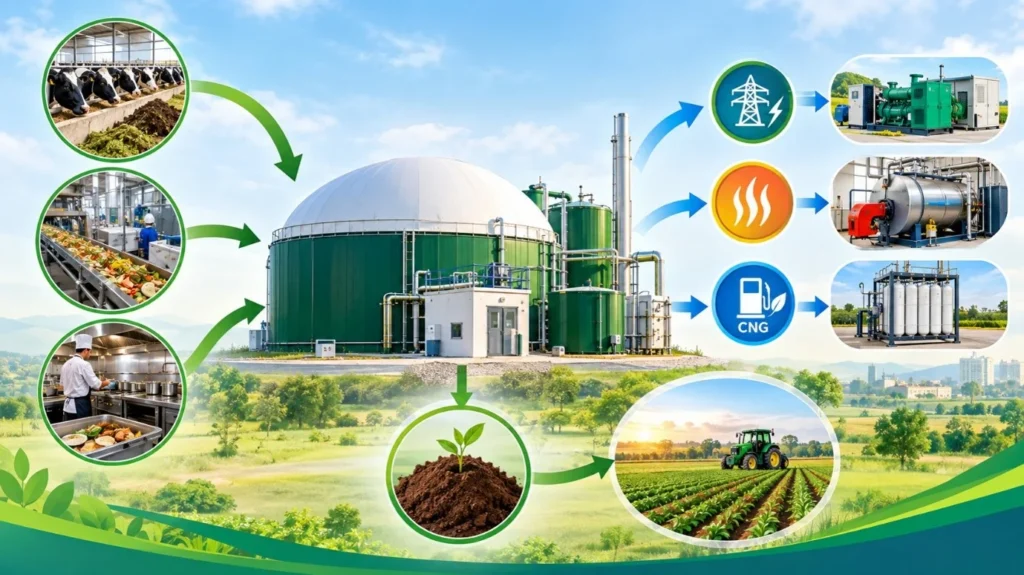
1. Waste management
A biogas plant gives organic waste a productive, controlled treatment route. Instead of sending it to landfill or dumping it, a business processes it on site or nearby.
2. Renewable energy generation
The gas can provide thermal energy, electricity through CHP, cooking fuel, or upgraded fuel, depending on your needs.
3. Potential cost savings
Savings depend on feedstock availability, your existing energy costs, plant efficiency and operating conditions. A reliable feasibility study gives a realistic picture of what to expect for your site.
4. Reduced dependence on conventional fuels
Biogas can substitute for fuels such as LPG, furnace oil, diesel or grid power in suitable applications, reducing exposure to price movements.
5. Digestate utilisation
Digestate can be used as a soil amendment or fertiliser, subject to applicable standards and quality checks. It can also be processed into more stable forms.
6. Environmental benefits
Anaerobic digestion captures methane that would otherwise escape from decomposing waste and puts it to productive use. The actual impact depends on the baseline, the plant’s operation and how gas is used, so claims should be made carefully.
7. Circular economy
Waste that once cost money to dispose of becomes an input for energy and agriculture. For many businesses, this also supports sustainability reporting and stakeholder commitments.
How to Select the Top Biogas Manufacturer in India
The phrase “top biogas manufacturer in India” appears in a lot of marketing. In practice, the right manufacturer for you is the one whose capabilities fit your project’s requirements and who can prove it. Use the checklist below.
| Criterion | What to look for |
| Experience | Proven work with feedstocks similar to yours |
| Engineering capability | In-house process, mechanical, civil, electrical and instrumentation engineering |
| Manufacturing capability | Own or well-controlled fabrication of critical equipment |
| EPC execution | Track record of delivering complete plants, not only supplying parts |
| Feedstock expertise | Willingness to test and characterise your waste |
| Customisation | Designs tailored to your site rather than a fixed catalogue |
| Quality control | Documented inspection, testing and material standards |
| Safety systems | Gas detection, pressure relief, flare, hazardous-area compliance |
| Automation | Sensible instrumentation and remote monitoring |
| Installation | Own or supervised site teams with clear responsibility |
| Commissioning | Structured start-up, stabilisation and performance checks |
| Operation and maintenance | Operator training and ongoing support options |
| Warranty | Clear terms on equipment and performance |
| Spare parts | Availability and lead times |
| Technical support | Responsiveness after handover |
| Project references | Verifiable projects you can inquire about |
| Documentation | Drawings, manuals, P&IDs, test records |
| Commercial proposal | Transparent scope, exclusions and payment terms |
| Lifecycle cost | Evaluation of operating and maintenance costs, not only capital cost |
Practical Tips:
- Ask for references and, where possible, visit an operating plant.
- Compare proposals on scope, not only price. A lower quotation often leaves out items you will pay for later.
- Check who is responsible for what, especially at interfaces such as civil works, utilities and statutory approvals.
- Be cautious about any supplier who quotes firm gas yields before seeing your feedstock.
Why Choosing the Right Biogas EPC Contractor Matters
Biogas projects fail less often because of the technology itself than because of avoidable execution errors. The wrong Biogas EPC Contractor can expose you to:
- Incorrect plant sizing: an oversized plant wastes capital, and an undersized one cannot handle the waste.
- Poor feedstock assessment: designs based on assumptions rather than analysis lead to unstable digestion.
- Process inefficiencies: low gas yield or frequent upsets.
- Delayed execution: poor planning and weak site coordination.
- Higher operating costs: inefficient equipment, excess power use or frequent breakdowns.
- Maintenance challenges: poor access, wrong materials or unavailable spares.
- Poor gas quality: high H₂S or moisture damaging engines and burners.
- Equipment compatibility issues: components that do not work together.
- Insufficient commissioning support: a plant handed over before it is stable.
How an experienced EPC contractor reduces these risks
- Starts with site survey and feedstock analysis, not assumptions
- Designs the plant as an integrated system
- Specifies equipment that suits the duty and the environment
- Plans construction sequencing and manages site safety
- Supports commissioning until the process is stable
- Trains your operators and stays available for technical support
Choosing an EPC partner is really a decision about who will carry the technical and delivery risk of your project.
Factors That Affect Biogas Plant Cost in India
Biogas plant cost varies widely, and any single number quoted without context can mislead. These are the main cost drivers:
- Plant capacity and the volume of feedstock handled
- Feedstock type and its characteristics
- Feedstock preparation requirements such as shredding, screening and de-packaging
- Digester design and construction material
- Civil construction including foundations, tanks and receiving areas
- Gas cleaning for H₂S, moisture and particulates
- Gas upgrading if Bio-CNG/CBG is planned
- Compression and storage
- CHP equipment if power generation is planned
- Automation and instrumentation
- Site conditions such as soil, space, water availability and grid access
- Piping and electrical systems
- Installation and site labour
- Transportation of equipment
- Commissioning and stabilisation
- O&M requirements over the plant’s life
Two plants of the same nominal size can differ greatly in cost because of these factors. Comparing quotations therefore requires care. Ask each supplier what is in scope, and what is excluded, before comparing totals.
For that reason, a customised quotation based on your feedstock, site and gas-use plan is far more reliable than a generic price per unit.
Biogas Plant Installation Process
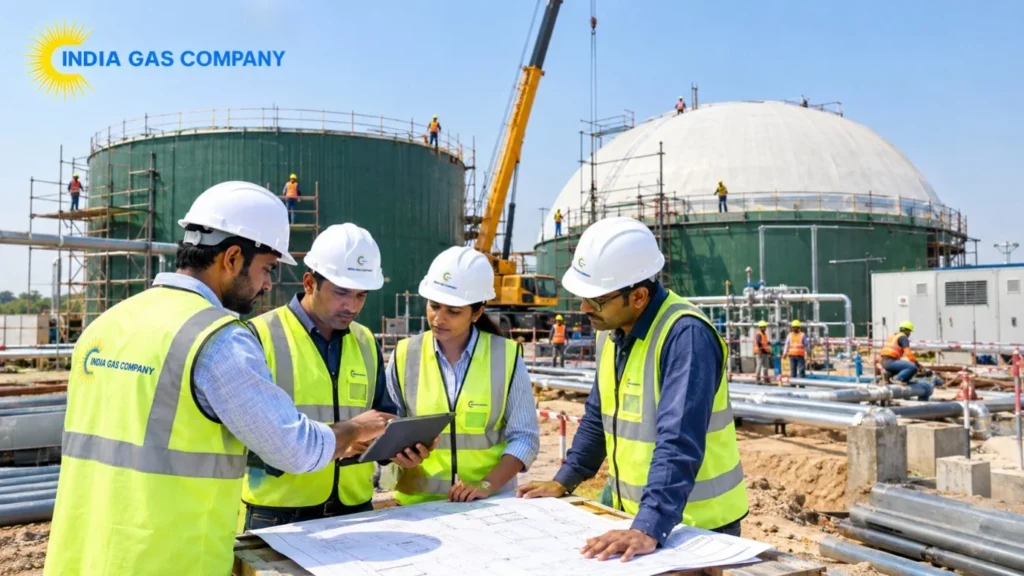
A well-managed biogas project follows a clear sequence:
- Initial consultation: understanding your goals, waste streams and energy needs.
- Site survey: evaluating space, access, utilities and constraints.
- Feedstock analysis: testing and characterising the waste.
- Feasibility study: assessing technical and commercial viability.
- Conceptual design: selecting the process and preliminary layout.
- Detailed engineering: developing drawings, specifications and control philosophy.
- Commercial proposal: presenting scope, timeline and commercial terms.
- Equipment manufacturing/procurement: fabricating and sourcing equipment.
- Civil construction: foundations, tanks and structures.
- Equipment installation: digester internals, gas holder, pumps, agitators and related equipment.
- Piping and electrical works: interconnections, cabling and control systems.
- Testing: leak, pressure and functional tests.
- Commissioning: seeding, gradual loading and stabilisation.
- Performance monitoring: tracking gas production and process parameters.
- Operator training: so your team can run the plant confidently.
- Ongoing support: service, spares and troubleshooting.
Timelines depend on project size, statutory approvals, equipment lead times and site readiness. A reliable contractor will give you a realistic schedule after assessing your project.
How to Calculate the Potential of a Biogas Project
Before investing, you should understand how much gas your waste can realistically produce and how you will use it. These are the main inputs:
- Daily feedstock quantity: how much waste is reliably available
- Total solids (TS): the dry matter in the feedstock
- Volatile solids (VS): the organic portion that can be converted into gas
- Moisture: affects handling and digester design
- Organic loading rate: how much VS the digester receives per unit volume per day
- Retention time: how long feedstock remains in the digester
- Expected gas yield: depends on feedstock, process and operating conditions
- Methane concentration: determines energy content
- Energy demand: what you actually need, in heat, power or fuel
- Gas utilisation method: boiler, engine, upgrading, or a combination
- Digestate output: volume and how you will manage it
- Operating costs: power, labour, maintenance, consumables
Why a professional feasibility study beats a generic calculator?
Online calculators use average values that may not match your waste. Real feedstocks vary in solids, biodegradability, contamination and seasonal availability. A professional assessment uses laboratory analysis and engineering judgment, considers your energy use and site, and produces a more dependable basis for investment decisions.
Applications of Biogas in Different Industries
Dairy Industry
Dairy operations generate cattle dung, wash water and, in processing units, whey and other dairy effluents. Biogas can supply thermal energy or electricity for the dairy and reduce manure management burdens. Digestate can go back to fodder and crop fields.
Food Processing Industry
Peels, trimmings, rejects, off-spec products and effluents are usually biodegradable. Biogas can supply process heat or power, and on-site treatment reduces disposal costs and handling.
Hotels and Hospitality
Hotels and resorts produce daily food waste from kitchens and banquets. A compact commercial biogas plant can convert this into cooking gas or heat, and supports responsible waste management commitments.
Distilleries
Distilleries produce high-strength spent wash. Anaerobic treatment reduces organic load while capturing energy, though sulphate content requires strong H₂S control and careful design.
Agriculture
Farm residues, manure and crop waste can be converted into energy for on-farm use, and digestate can supplement soil nutrients.
Sugar Industry
Sugar and allied units generate press mud, spent wash and other organic residues. Biogas can supplement energy needs and add value to by-products, with the design shaped by seasonal availability.
Municipal Waste Management
Segregated organic waste from households and markets can be treated in biogas plants, reducing landfill load and generating energy. Source segregation quality largely decides plant performance.
Pharmaceutical and Industrial Organic Waste
Some pharmaceutical and chemical processes produce biodegradable organic streams. Treatability must be studied carefully because certain compounds can inhibit digestion. Case-specific evaluation is essential.
Commercial Kitchens
Canteens, institutional kitchens and catering units generate consistent food waste. Compact systems can process it and offer cooking gas or heat, provided space and segregation are managed.
Poultry Industry
Poultry litter and waste are nutrient-rich but high in nitrogen, which can cause ammonia inhibition. With correct design and co-digestion strategies, biogas can provide farm energy and manage waste.
Biogas Manufacturer vs Biogas EPC Contractor: What is the Difference?
The terms overlap, and many companies do both. Understanding the difference helps you decide who to approach and how to structure your contract.
| Parameter | Biogas Manufacturer | Biogas EPC Contractor |
| Equipment manufacturing | Fabricates or supplies core equipment such as digesters, gas holders or skids | May manufacture some items but often sources equipment from multiple suppliers |
| Engineering | Focuses on the design of its own equipment | Designs the complete plant, including process, piping, electrical and controls |
| Procurement | Supplies its own product range | Procures all required equipment and materials for the full plant |
| Installation | May offer supervision or limited installation | Carries out or manages complete installation |
| Commissioning | Often supports commissioning of its own equipment | Responsible for commissioning the entire plant |
| Complete project responsibility | Generally limited to its supply scope | Takes end-to-end responsibility as defined in the contract |
| After-sales support | Equipment-level support and spares | Plant-level support, often including O&M and performance follow-up |
Why a combined provider can be attractive A company that is both a biogas plant manufacturer and EPC contractor can control quality at the source, design equipment around the plant, and take responsibility for the whole system. That can mean fewer interface issues, better accountability and easier support later. Whichever route you choose, insist on clear scope and responsibility in writing.
Questions to Ask Before Hiring a Biogas Manufacturer
Use these questions when meeting suppliers:
- What feedstocks have you handled?
Ask for examples similar to yours. - What is your engineering approach?
Look for a structured process, not a catalogue pitch. - Can you conduct a site survey?
A serious supplier will insist on one. - How is plant capacity determined?
The answer should refer to your feedstock data and energy needs. - What gas utilisation options are available?
Heat, power, Bio-CNG or a combination. - What equipment is included in your scope?
Ask for a detailed equipment list. - Who handles installation?
Clarify whether it is your contractor or theirs. - Who handles commissioning?
And how long will they stay involved? - What safety systems are included?
Gas detection, pressure relief, flare, hazardous-area design. - What automation is provided?
Instrumentation, control panels, remote monitoring. - What after-sales support is available?
Response times, service visits, spares. - What is the expected project timeline?
With key milestones and dependencies. - What documentation will be provided?
P&IDs, layouts, manuals, test records. - What maintenance support is available?
Preventive maintenance and AMC options. - What is excluded from your quotation?
Often the most revealing question. - Can I speak to existing customers?
References should be verifiable.
Why Businesses Should Consider a Turnkey Biogas Solution
A turnkey biogas plant is delivered as a complete, working system. You receive a plant that is ready to operate rather than a collection of equipment to integrate yourself.
Key benefits:
- Single point of responsibility: one party answers for the result.
- Better coordination: engineering, supply and construction are aligned.
- Integrated engineering: components are designed to work together.
- Simplified procurement: you avoid managing many suppliers.
- Better installation coordination: fewer clashes between civil, mechanical and electrical work.
- Faster issue resolution: problems are addressed by one accountable team.
- Easier commissioning: the party that designed the plant also starts it up.
- Ongoing technical support: continuity from design through operation.
For industrial and Bio-CNG projects in particular, where gas quality, safety and integration are critical, a turnkey model handled by an experienced Biogas EPC Contractor lowers risk significantly. Turnkey does not mean you have no role. You still need to define your requirements clearly and review key decisions.
Why Choose India Gas Company for Your Biogas Project?
India Gas Company approaches biogas as an engineering problem to solve, not a product to sell. Every plant begins with your feedstock, your site and your energy objectives.
- Biogas Plant Manufacturing
- Customised Plant Design
- Turnkey EPC Solutions
- Engineering Expertise
- Project Execution
- Installation and Commissioning
- Automation
- Gas Purification and Upgrading
- Operation and Maintenance Support
- Industry-Specific Solutions
- Certifications and Standards
Our approach is straightforward: understand your waste, define the right technology, engineer it properly, build it carefully and support it after commissioning.
Looking for a reliable biogas manufacturer or Biogas EPC Contractor in India? Contact India Gas Company to discuss your feedstock, capacity requirements, site conditions and energy goals. Our team can help evaluate your project and recommend a suitable biogas solution.
Frequently Asked Questions
1. What is a Biogas Plant?
A biogas plant is a facility that treats organic waste through anaerobic digestion and captures the resulting gas. The gas can be used for heat, electricity or upgraded fuel, and the remaining digestate can be used as a soil amendment where standards permit.
2. Who is the Top Biogas Manufacturer in India?
There is no single, universally accepted ranking. The top biogas manufacturer in India for your project is the one with proven experience in your feedstock, strong engineering, reliable execution and long-term support. Evaluate suppliers on verifiable references, scope and technical capability rather than claims.
3. What does a Biogas EPC Contractor do?
A Biogas EPC Contractor handles engineering, procurement and construction for the entire plant, including design, equipment supply, installation, testing and commissioning, under a defined scope and schedule.
4. How much does a biogas plant cost in India?
Cost depends on capacity, feedstock, preparation needs, gas cleaning or upgrading, automation, site conditions and more. Because these factors vary so much, a customised quotation based on a feasibility assessment is the reliable way to estimate biogas plant cost.
5. Which industries can use biogas plants?
Dairy farms, food processors, distilleries, hotels, sugar and agro industries, poultry units, municipal bodies, waste management companies, and some pharmaceutical and chemical units can all use biogas, depending on the waste they generate.
6. What waste can be used to produce biogas?
Cattle dung, food and vegetable waste, agricultural residues, dairy and poultry waste, distillery effluent, sewage sludge and various industrial organic wastes can all be used. Suitability depends on the waste’s composition and contaminants.
7. How long does it take to install a biogas plant?
The timeline depends on plant size, engineering scope, equipment lead times, approvals and site readiness. Your EPC contractor should give a realistic schedule after the site survey and design stage.
8. Can biogas be converted into Bio-CNG?
Yes. Raw biogas can be cleaned, upgraded by removing CO₂, and compressed to produce Bio-CNG/CBG. This requires additional equipment and stricter engineering and safety practices.
9. What factors affect biogas production?
Feedstock type and quality, organic loading, temperature, pH, retention time, mixing, the presence of inhibitors and overall process stability all influence gas production.
10. How do I select a biogas manufacturer?
Assess experience with similar feedstocks, engineering and manufacturing capability, EPC execution record, safety systems, commissioning and after-sales support, and verifiable references. Compare proposals on scope and lifecycle cost, not only price.
11. Is a turnkey biogas plant better for industrial applications?
For most industrial applications, a turnkey approach offers clearer responsibility, better coordination and simpler project management. It is especially valuable where gas quality, safety and integration with existing operations are critical.
12. What maintenance does a biogas plant require?
Routine maintenance includes checking pumps, agitators, gas systems, instruments and safety devices, monitoring process parameters, cleaning filters, and servicing gas engines or compressors where installed. A maintenance schedule from your contractor helps prevent downtime.
13. Can a biogas plant be customised?
Yes. Industrial biogas plants are generally designed around your feedstock, capacity, site and gas-use requirements rather than being fixed models.
14. What information is required for a biogas plant quotation?
Typically: type and quantity of feedstock, availability pattern, site location and layout, available utilities, intended gas use, current energy consumption, and any project timeline or budget constraints. Feedstock samples for analysis are highly useful.
15. How can I start a biogas project with an EPC contractor?
Begin with an initial consultation, share your feedstock and site details, and request a site survey and feasibility assessment. After reviewing the proposal, finalise scope and commercial terms, then move to detailed engineering and execution.
Conclusion
Biogas technology offers Indian businesses a practical way to manage organic waste and generate useful energy from it. Whether the goal is process heat, captive power or Bio-CNG, the outcome depends far more on engineering quality than on equipment alone.
Feedstock analysis, correct plant sizing, sound process design, proper gas cleaning, thoughtful safety systems and careful commissioning are what separate a plant that performs reliably from one that struggles. That is why the choice of manufacturer matters. The top biogas manufacturer in India for your project is the one that can demonstrate relevant experience, transparent proposals and the capability to support the plant for years.
A capable Biogas EPC Contractor brings all these pieces together under one responsibility. Instead of managing several vendors and interfaces, you work with a partner accountable for design, supply, construction and commissioning. Each project is different, so a customised assessment of your feedstock, site and energy needs should always come before any final decision or price.
If you are planning a biogas project, the most useful next step is a technical discussion. Contact India Gas Company for a consultation, feasibility assessment, quotation or turnkey project requirement. Share your waste type, quantity and energy goals, and our team will help you evaluate options and plan a solution that fits your business.
You May Also Like:
🔗 Dry Ice Manufacturer and Supplier in Bangalore
🔗 CO2 Production, Generation and Recovery Plants


1 thought on “Top Biogas Manufacturer in India: Complete Guide to Biogas Plants and EPC Solutions”