

What Does It Really Cost to Build a Biogas Plant in India?
If you are searching for biogas plant cost in India, you have probably noticed that there is no single answer. A household unit that runs a kitchen stove costs a small fraction of what a commercial Bio-CNG plant costs, and a dairy farm digester sits somewhere in between. Even two plants of the same size can differ sharply in price depending on feedstock, technology, location and scope of supply.
That is why serious investors, dairy owners, agricultural entrepreneurs and industrial buyers need more than a headline number. They need to understand where the money goes, which choices move the budget up or down, and how cost connects to long-term returns.
This guide from India Gas Company breaks down the biogas plant installation cost into its building blocks: equipment, civil and mechanical work, gas upgrading, approvals, commissioning and the often-forgotten pre-operative expenses. We also cover operating costs, subsidies and financing, payback logic and the common mistakes that inflate budgets.
Want a project-specific cost estimate instead of a generic range? Request a preliminary budget from India Gas Company. Contact details are at the end of this article.
A note on numbers: Every figure in this article is an indicative range meant to help you plan. Equipment prices, steel and cement costs, exchange rates and policy incentives change over time, so a site-specific detailed project report (DPR) and supplier quotations are essential before any investment decision.
Types of Biogas Plants and Their Typical Cost Ranges
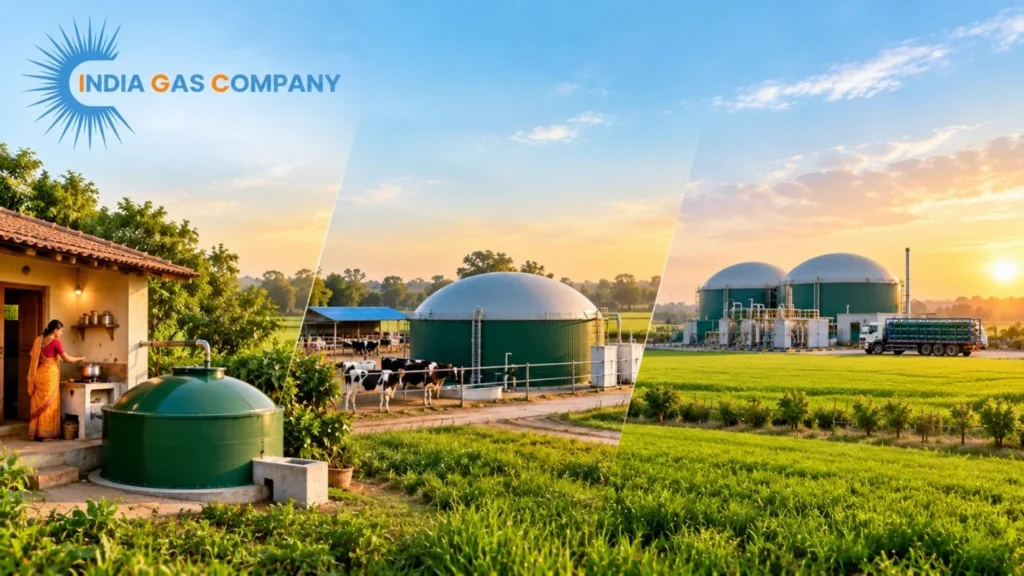
The first factor in any budget is the type and scale of the plant. In India, projects broadly fall into four categories.
1. Household and small-farm biogas plants (1 to 10 m³ per day)
These are the familiar family-size units, usually fixed-dome or floating-drum designs or prefabricated flexible and fibre-reinforced models, fed with cattle dung and kitchen waste. They supply cooking gas and slurry manure. Costs are low, typically in the range of tens of thousands of rupees, and central and state subsidies have historically been available for eligible beneficiaries under national biogas programmes.
2. Community and dairy-farm biogas plants (10 to 500 m³ per day)
These serve a dairy, a gaushala, a hostel, a small food processor or a village cluster. Gas is used for cooking, heating, or small engines for electricity. Budgets commonly run from a few lakh to a few tens of lakh rupees, depending on size, digester material, gas storage and whether power generation is included.
3. Biogas-to-power plants (50 kW to several MW)
These use gas engines to generate electricity and heat from dung, food waste, industrial effluent, press mud or energy crops. As a rough planning guide, installed cost is often discussed in the range of several crore rupees per MW, with wide variation depending on feedstock handling, engine brand, grid connection and heat recovery.
4. Compressed Biogas (CBG or Bio-CNG) plants (1 TPD and above)
These are industrial projects that clean and upgrade biogas to vehicle- and pipeline-grade fuel. They need large digesters, robust feedstock handling, gas upgrading, compression and dispensing or cascade filling facilities. Costs are usually measured in crore rupees per tonne per day (TPD) of CBG capacity.
Indicative budget snapshot
| Plant category | Typical capacity | Indicative project cost range* |
| Household biogas plant | 1–6 m³/day | ₹ 25,000 – ₹ 80,000 |
| Dairy / community plant | 25–200 m³/day | ₹ 3 lakh – ₹ 40 lakh |
| Biogas power plant | 100 kW – 2 MW | ₹ 1 crore – ₹ 25 crore |
| Small CBG plant | 1–2 TPD | ₹ 7 crore – ₹ 20 crore |
| Medium CBG plant | 5 TPD | ₹ 30 crore – ₹ 50 crore |
| Large CBG plant | 10 TPD | ₹ 55 crore – ₹ 95 crore |
Order-of-magnitude planning figures only. Actual cost depends on feedstock, scope, technology, location and prevailing market prices, and may exclude land and working capital.
Biogas Plant Cost Breakdown: Where Does the Money Go?
For a commercial CBG or biogas-to-power project, the capital cost is spread across several heads. The exact split varies, but the pattern below is a useful mental model.
| Cost head | Approximate share of capex* |
| Digesters, gas holders and civil structures | 25% – 35% |
| Feedstock receiving, pre-treatment and storage | 8% – 15% |
| Gas cleaning, upgrading and compression | 15% – 25% |
| Mechanical piping, pumps, agitators and heating | 8% – 12% |
| Electrical, automation and instrumentation | 5% – 10% |
| Digestate handling and FOM processing | 3% – 8% |
| Land development, roads, utilities and buildings | 5% – 10% |
| Statutory approvals, engineering, pre-operative and contingency | 5% – 10% |
Indicative shares that differ by project type and design philosophy.
The next sections explain each head in practical terms.
Biogas Plant Equipment: What You Are Actually Paying For
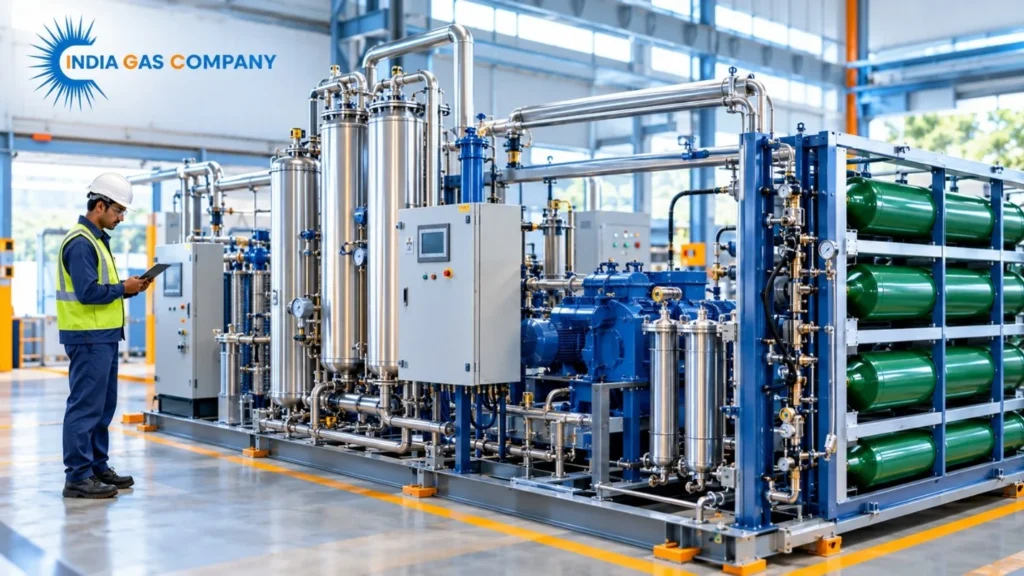
1. Feedstock receiving and pre-treatment equipment
The feedstock system decides whether the plant runs smoothly or not. Depending on whether you use cattle dung, Napier grass, press mud, poultry litter, food waste or agricultural residue, this section may include:
- Weighbridge for incoming material accounting
- Receiving pits, hoppers and conveyors
- Chopping, shredding or size-reduction machines (essential for fibrous crops like Napier grass)
- De-stoning and contaminant removal systems
- Mixing and equalisation tanks to homogenise feed
- Silage bunkers or storage pads for seasonal biomass
- Solid feeders or pumps to dose feed into the digester
Solid, fibrous feedstocks need heavier, costlier handling equipment than liquid dung or effluent. This is one of the biggest reasons two plants of equal gas output can differ in price.
2. Digesters (anaerobic digestion tanks)
The digester is the heart of the plant. Typical options include:
- RCC (reinforced cement concrete) tanks: durable, widely used, and cost-efficient at large volumes, but dependent on good civil workmanship and waterproofing.
- Glass-fused-to-steel (GFS) or coated steel tanks: faster to install and consistent in quality, though material cost can be higher.
- Covered lagoons or flexible-membrane digesters: lower cost for suitable liquid manure, with trade-offs in temperature control and gas capture.
Digester volume depends on feedstock quantity and hydraulic retention time (HRT). Fibrous crops need longer retention, and therefore larger tank volume, than easily digestible slurry. Insulation, heating coils and roof design add further cost.
3. Gas holders and gas storage
Biogas is produced continuously but used or upgraded at varying rates. Double-membrane gas holders are commonly used for storage and pressure balance. Their size depends on how much buffer the plant needs.
4. Agitators, pumps and heating systems
Mixing prevents crust formation and dead zones. Options include submersible, central-shaft or paddle agitators. The plant also needs transfer pumps, recirculation pumps, heat exchangers or boilers to hold the digester at stable mesophilic temperatures, plus valves, piping and instrumentation. Cold-climate or high-altitude sites need extra heating capacity.
5. Biogas cleaning equipment
Raw biogas contains moisture, hydrogen sulphide and other impurities. Cleaning typically involves:
- Desulphurisation: biological, chemical or activated carbon systems
- Moisture removal: chillers, condensate traps and dryers
- Siloxane or VOC filters in some feedstock situations
6. Biogas upgrading (CO₂ removal) technology
For CBG, methane must be separated from carbon dioxide. Common options include:
| Technology | Key characteristics |
| Membrane separation | Compact, modular, widely used in India; good for small to mid scale |
| Pressure swing adsorption (PSA) | Mature, reliable, good methane purity |
| Water scrubbing | Simple chemistry, but needs large water handling |
| Amine scrubbing | High methane recovery, with higher heat demand and process complexity |
The choice affects capital cost, electricity or heat consumption, and methane slip, which directly impacts revenue.
7. Compression, storage and filling systems
CBG must be compressed to high pressure for transport. The package usually includes compressors, dryers, buffer storage, cascades of high-pressure cylinders, dispensing or filling systems and flow metering. Cascade trucks or tube trailers add to the budget if the plant owns its logistics.
8. Power generation equipment (for biogas-to-power projects)
Gas engines or gensets, heat-recovery units, transformers, switchgear, synchronisation panels and grid-connection infrastructure make up this block. Engine brand, warranty and service support heavily influence price.
9. Flare and safety systems
An enclosed or open flare handles surplus or off-spec gas safely. Also included are gas detectors, flame arrestors, pressure relief valves, emergency shutdown logic, fire protection and earthing.
10. Electrical, automation and SCADA
Motor control centres, cabling, PLC and SCADA systems, analysers for methane, CO₂, H₂S and oxygen, flow meters and remote monitoring enable stable operation. More automation raises capital cost slightly but typically lowers labour needs and process upsets.
11. Digestate and fertiliser handling
A solid-liquid separator (screw press or decanter), storage lagoons, FOM composting or drying facilities, and liquid fertiliser tanks convert digestate into saleable products. This block is often underestimated at the budgeting stage.
12. Effluent management and utilities
Water supply, effluent treatment where required, rain-water diversion, roads, boundary wall, laboratory, control room, storage sheds and workshop all add up.
Not sure which technology suits your feedstock and budget? Speak to India Gas Company’s engineering team for an equipment-level cost review.
Biogas Plant Installation Cost: What Does Installation Include?

Equipment cost is only part of the story. Installation and construction can be a substantial share of the budget and is often where overruns appear. Installation typically covers:
Civil and structural work
Earthworks, foundations, digester tank construction, silage pads, lagoons, drainage, internal roads and buildings. Black cotton soil, a high water table, seismic zones or poor site access can increase civil cost significantly.
Mechanical erection and piping
Placement of tanks, agitators, pumps and skids, plus gas, slurry, water and condensate piping. Material grade (stainless steel versus carbon steel versus HDPE) and total pipe length influence cost.
Electrical and instrumentation installation
Cable laying, panel installation, earthing, lightning protection, instrument calibration and SCADA integration.
Inoculation and start-up
A new digester needs active microbial inoculum, often sourced from existing biogas plants or cattle slurry. Start-up involves gradual feeding and close monitoring, and it can take several weeks to months to reach design capacity.
Testing, commissioning and performance trials
Leak testing, hydro testing, gas quality checks and performance guarantee runs. Skipping or compressing this stage invites future problems.
Approvals and consultancy
Consent from the State Pollution Control Board, safety and pressure-vessel approvals, electrical inspection, land-use permissions, grid or gas-network connectivity studies and DPR preparation all carry fees and timelines.
Typical installation timeline
| Project type | Typical build time (from order to commissioning) |
| Small farm or dairy plant | 2 – 6 months |
| Biogas power plant | 9 – 15 months |
| CBG plant | 12 – 24 months, including approvals |
Longer timelines raise financing costs, so planning approvals and supply chains early pays off.
Key Factors That Affect Biogas Plant Cost in India
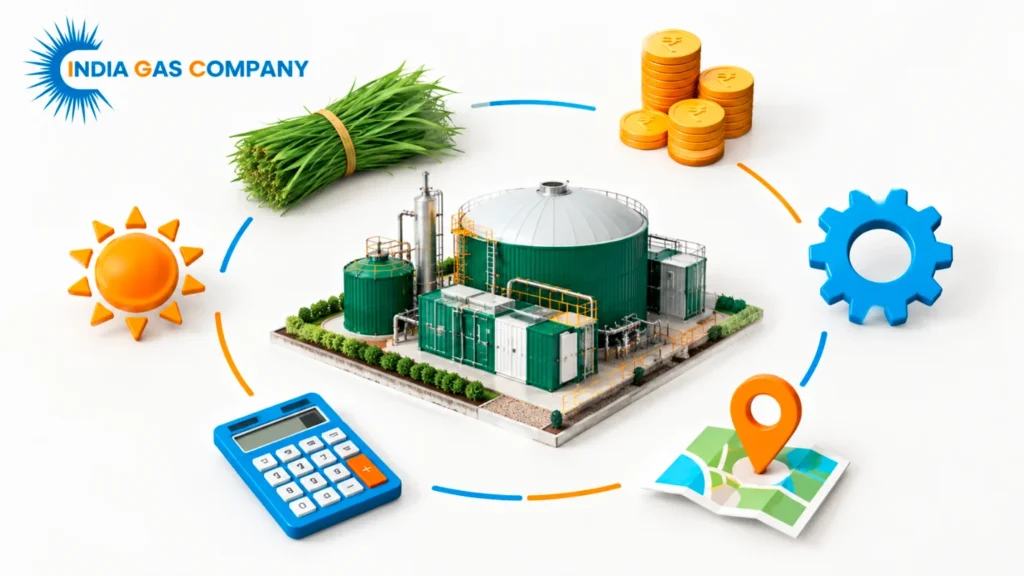
Here are the variables that most often explain why quotations differ.
1. Plant capacity and scale
Larger plants benefit from economies of scale: cost per unit of output generally falls as capacity grows, because many systems do not scale linearly. However, bigger plants also need larger feedstock catchments, so the saving can be offset by logistics.
2. Type and quality of feedstock
This is the single biggest technical driver.
- Cattle dung and liquid manure: easy to digest and handle, lower pre-treatment cost, but lower gas per tonne.
- Napier grass and energy crops: higher gas yield per tonne, but need chopping, silage, robust feeders and longer retention time.
- Press mud, agricultural residue and poultry litter: may need special feeding, ammonia management or dilution.
- Food and municipal organic waste: need sorting, de-packaging and contaminant removal, which raises pre-treatment cost.
- Industrial effluent: may need high-rate reactors and sulphur management.
A mixed or variable feedstock requires more flexible, and therefore more expensive, design.
2. Choice of digester technology
CSTR, plug-flow, covered lagoon, UASB for effluents and dry fermentation each have different cost structures. The right choice depends on solids content, feedstock type and operating philosophy. A cheaper design that mismatches the feedstock tends to become the most expensive option over time.
3. Gas end-use: cooking, power or CBG
Cooking gas needs minimal cleaning. Power generation needs engines and grid work. CBG needs the full cleaning, upgrading and compression train. The more refined the product, the higher the capital cost, but also the higher the revenue per unit of gas.
4. Upgrading and compression technology
Membrane, PSA, water scrubbing and amine systems differ in capex, power consumption, methane recovery and footprint. Imported premium systems usually cost more upfront than indigenous ones, but may offer better recovery and service.
5. Degree of automation
Basic manual operation is cheaper to build, but a highly automated plant with SCADA, remote monitoring and online analysers reduces human error and downtime.
6. Equipment origin and brand
Imported digester components, agitators, engines, compressors and membranes can cost more than indigenous equivalents, though not always. Consider total cost of ownership, including spare parts, service response time and warranty.
7. Site conditions and location
Soil type, topography, water availability, road access, distance from the feedstock source, distance to the gas offtake point or grid, and local labour and material rates all shape cost. A remote site increases transport and mobilisation expense.
8. Land cost and land development
Land price varies enormously by state and district. Do not forget levelling, boundary fencing, drainage, approach roads and storage area for feedstock and digestate. Captive Napier cultivation, if planned, requires additional land and irrigation investment.
9. Utilities and connectivity
Grid power availability, a gas pipeline or cascade logistics, water supply and effluent discharge are all potential cost items. Grid or pipeline connection charges alone can be significant.
10. Climate and temperature control
Plants in cold regions need more insulation and heating. Hot, humid regions may need extra attention to corrosion protection and gas conditioning.
11. Safety and regulatory requirements
Explosion-proof electricals, gas detection, fire fighting, pressure-vessel certification and environmental compliance are non-negotiable. They add cost but protect both people and investment.
12. Redundancy and spare capacity
Stand-by pumps, extra digester capacity, a second compressor or buffer storage improve uptime but raise capital cost. The right level of redundancy depends on how costly downtime is for your business.
13. Contracting model: EPC, turnkey or split packages
A single-point EPC or turnkey contract usually costs more on paper but transfers integration and performance risk to the contractor. Splitting packages can reduce price but increases coordination risk and the owner’s workload.
14. Financing structure and interest during construction
Debt cost, margin money, processing fees and interest during construction add to total project cost. Delays directly increase these charges.
15. Inflation, steel and cement prices, and foreign exchange
Commodity swings and currency movements can change quotations between the DPR stage and order placement. Price-variation clauses in contracts should be understood clearly.
Operating Cost of a Biogas Plant: Do Not Budget Only for Capex
A plant that is cheap to build but expensive to run is not a bargain. Typical operating expense items include:
- Feedstock cost: collection, cultivation, purchase and transport. For crop-based plants this is often the largest recurring cost.
- Electricity and heat for pumps, agitators, upgrading and compression
- Manpower: operators, supervisors, lab and maintenance staff
- Maintenance and spares: membranes, filter media, compressor overhauls, pump parts
- Chemicals and consumables: for desulphurisation and cleaning
- Water and effluent handling
- Insurance, statutory fees and overheads
- Logistics: cascade transport, digestate movement and manure distribution
A healthy planning habit is to model operating cost per kilogram of CBG or per kWh of electricity so that you can compare it with expected realisation.
Revenue, ROI and Payback: Linking Cost to Returns
Cost only makes sense when set against income. The main revenue streams are:
- Bio-CNG sales to oil marketing companies, city gas distributors or industrial buyers
- Electricity sales or captive savings for power projects
- Fermented organic manure (FOM) and liquid fertiliser
- Carbon credits, where applicable
- Captured CO₂ for suitable industrial users
- Tipping or waste-handling fees, where waste is received from municipalities or industries
Payback and return on investment depend on feedstock cost, plant uptime, gas yield, offtake price, subsidy support and financing cost. Well-designed projects with secured feedstock and offtake commonly target payback periods in the range of several years, but the number must be derived from a project-specific financial model, not a rule of thumb.
Quick example of how cost drivers move returns
Imagine two projects of the same CBG capacity. Project A buys cheap, easy-to-digest feedstock, runs at high uptime and sells FOM. Project B uses costly feedstock, suffers frequent downtime and dumps digestate. Their capital costs may look similar, yet their returns can differ dramatically. Operational discipline and feedstock strategy often matter as much as the capex figure.
Need a financial model for your project? India Gas Company can help you prepare a DPR with capex, opex, revenue and sensitivity analysis.
Subsidies, Incentives and Financing Options in India

Government support can reduce effective project cost. Schemes and amounts are revised periodically, so verify current terms before relying on any of them.
- National Bio-Energy Programme (MNRE): offers central financial assistance for eligible biogas, bio-CNG and bio-energy projects, usually capped per project or per unit capacity and subject to technical and eligibility conditions.
- National Biogas Programmes for Family and Community Plants: have historically provided subsidies and support for small plants and rural beneficiaries.
- SATAT Initiative: provides a structured market for CBG producers through oil marketing company offtake arrangements.
- GOBARdhan: supports conversion of cattle dung and organic waste into biogas and bio-manure.
- Compressed Biogas Blending Obligation: builds long-term demand for CBG.
- Market Development Support for FOM: encourages sale and use of organic manure from biogas plants.
- Concessional Financing: specialised lenders and banks offer loans for renewable energy, and biogas may qualify for priority-sector treatment in some cases.
- State-level Incentives: capital subsidies, stamp duty or electricity-duty exemptions, land concessions and single-window approvals vary by state.
Smart financing tips:
- Combine term loans with equity and eligible subsidy for a balanced structure.
- Arrange offtake agreements before approaching lenders. They improve bankability.
- Keep adequate margin for working capital, especially for crop-based feedstock cycles.
- Check whether subsidy is released upfront, on commissioning, or after performance testing, so that cash flow is planned correctly.
Common Mistakes That Inflate Biogas Project Cost
Many budget overruns are avoidable. Watch for these pitfalls.
- Choosing technology before confirming feedstock. Always validate feedstock availability, quality and price first.
- Using unrealistic gas-yield assumptions. Insist on laboratory biochemical methane potential (BMP) testing.
- Underestimating pre-treatment and storage. Fibrous or contaminated feedstock needs proper handling.
- Ignoring digestate. If it cannot be used or sold, it becomes a disposal cost.
- Selecting the lowest bidder without checking references. Cheap equipment can lead to costly downtime.
- Skipping contingency. A reserve of several percent protects against surprises.
- Overlooking approvals and utility connections. Delays here raise interest during construction.
- No operator training or O&M plan. Poor operation can waste the capital you spent on good equipment.
- Oversizing the plant. Capacity built ahead of reliable feedstock sits idle.
- Neglecting safety design. A single incident can cost far more than the safety budget would have.
How to Estimate Your Biogas Plant Cost: A Practical Checklist
Use this step-by-step approach to move from a vague idea to a credible budget.
- Define the objective: cooking gas, on-farm power, industrial heat or Bio-CNG sales.
- Quantify feedstock: type, tonnes per day, seasonality, distance, price and contract security.
- Run BMP and feedstock analysis: confirm gas yield, solids content and any inhibitors.
- Select the capacity and technology: digester type, upgrading option, power or CBG route.
- Survey the site: soil tests, topography, water, road access, power and gas connectivity.
- Request detailed quotations: from multiple suppliers on a clear, comparable scope.
- Add the non-equipment costs: land development, approvals, pre-operative expenses, working capital and contingency.
- Build the financial model: capex, opex, revenue, subsidy, debt, taxes and sensitivity cases.
- Stress-test the numbers: lower yield, higher feedstock price, delayed commissioning and lower offtake price.
- Decide and secure funding: only after the stress test still gives acceptable returns.
Biogas Plant Cost by User Type: What Should You Expect?
Dairy farm owners
Start with a digester sized to your daily dung and wash-water volume. Costs are moderate, payback comes from saved fuel or electricity, and digestate replaces chemical fertiliser. Co-digesting with fodder crops can lift output without major redesign. Consider aggregating with neighbouring farms if scale is small.
Agricultural entrepreneurs and farmer groups
Your cost driver is feedstock security. Crop-based and residue-based plants need higher capex for handling, but they can produce a dependable energy product. Cooperative structures and contract farming can share risk and investment.
Industrial buyers
If you want Bio-CNG for process heat or fleet use, compare building your own plant against signing a long-term supply agreement. Owning a plant gives control but ties up capital. Buying gas preserves capital but exposes you to offtake terms.
Investors and developers
Focus on bankable structure: secured feedstock, long-term offtake, experienced EPC partner, clear subsidy path and conservative assumptions. Cost per TPD is only one metric. Cost per tonne of CBG produced over the project life is a more complete measure.
Whichever category you belong to, a free pre-feasibility discussion can save months of trial and error. Reach out to India Gas Company.
FAQs about Biogas Plant Cost in India
Q1. What is the cost of a biogas plant in India?
It ranges from tens of thousands of rupees for a household unit to tens of crores for a commercial CBG plant. The right figure for you depends on capacity, feedstock, technology and location, so a site-specific DPR is the only reliable answer.
Q2. How much does a 1 TPD or 5 TPD CBG plant cost?
Capital cost per TPD of capacity varies widely, and larger plants generally have lower cost per unit of output. Indicative planning ranges are shown in the table in this article, but they should be validated through quotations and detailed engineering.
Q3. What is the biogas plant cost in India for a dairy farm?
For a typical dairy farm, costs depend on herd size, daily dung volume, digester material and whether you add power generation. Small to mid-size farm plants are usually far cheaper than industrial projects and often pay back through fuel and fertiliser savings.
Q4. Is there a subsidy on biogas plants in India?
Yes, several central and state-level schemes exist, but eligibility, amounts and release conditions change from time to time. Check the latest guidelines or ask an advisor before building your financial model around any subsidy.
Q5. What is the biggest factor affecting biogas plant cost?
Feedstock type and scale are usually the biggest drivers, followed by the gas end-use route, upgrading technology, site conditions and the degree of automation.
Q6. How long does it take to set up a biogas plant?
Small plants can be built in a few months. Commercial CBG plants often need one to two years, including approvals, financing, construction and commissioning.
Q7. What are the annual running costs of a biogas plant?
Major items are feedstock, power and heat, manpower, maintenance and consumables. For crop-based plants, feedstock is typically the largest line item.
Q8. How can I reduce the cost of my biogas project without hurting performance?
Validate feedstock early, right-size the plant, choose proven technology, standardise equipment, use experienced contractors, secure subsidy and offtake, and avoid late design changes.
Q9. Can I start small and expand later?
Often yes, if the site layout, utilities and design allow for modular expansion. Plan for it from day one so that additional digesters or upgrading units can be added without rework.
Why Choose India Gas Company for Your Biogas Project?
Building a biogas plant is a multi-disciplinary effort involving feedstock science, process engineering, gas upgrading, finance and regulation. India Gas Company supports clients at every stage:
- Feasibility and pre-feasibility studies tailored to your feedstock and goals
- Feedstock assessment and BMP testing guidance
- Technology selection across digester, upgrading and compression options
- Detailed project reports with realistic capex, opex and return analysis
- EPC and turnkey execution support
- Commissioning, operator training and O&M guidance
- Help with subsidies, approvals and offtake agreements
Our approach is simple: transparent numbers, proven engineering and projects designed to perform for the long term.
Conclusion: Invest in Clarity Before You Invest in Concrete
The cost of a biogas plant in India is not a single number. It is the sum of many decisions: what you feed it, how you design it, what you do with the gas and digestate, where you build it and who builds it. A low upfront price can hide high operating costs, while a well-engineered plant with secured feedstock can deliver steady returns for decades.
Before committing capital, take time to define your objective, test your feedstock, compare technologies, build a conservative financial model and plan for approvals, subsidies and operations. That discipline is what separates a successful biogas project from an expensive disappointment.
Get Your Biogas Plant Cost Estimate from India Gas Company
Ready to turn your idea into a bankable project?
● Request a free pre-feasibility discussion with our biogas experts
● Get a customized cost estimate for your capacity, feedstock and location
● Ask for a sample DPR structure
● Call: +91-87971091010
● Email: info@indiagascompany.com
● Website: https://indiagascompany.com
India Gas Company: Powering India’s renewable energy future, one project at a time.
Disclaimer: Cost ranges, timelines and percentages in this article are indicative and intended for preliminary planning only. Actual project cost depends on feedstock, scope, technology, location, market prices and policy conditions, all of which change over time. Subsidy and incentive details should be verified with the relevant authorities before investment decisions. This article does not constitute financial or legal advice.
You May Also Like:
🔗 Napier Grass Biogas Plant Setup in India: A Complete Commercial Guide
🔗 Top Biogas Manufacturer in India: Complete Guide to Biogas Plants and EPC Solutions




1 thought on “Biogas Plant Cost in India: Equipment, Installation, and Factors Affecting Project Cost”
Dinesh mishra, mahuwariya mirzapur up