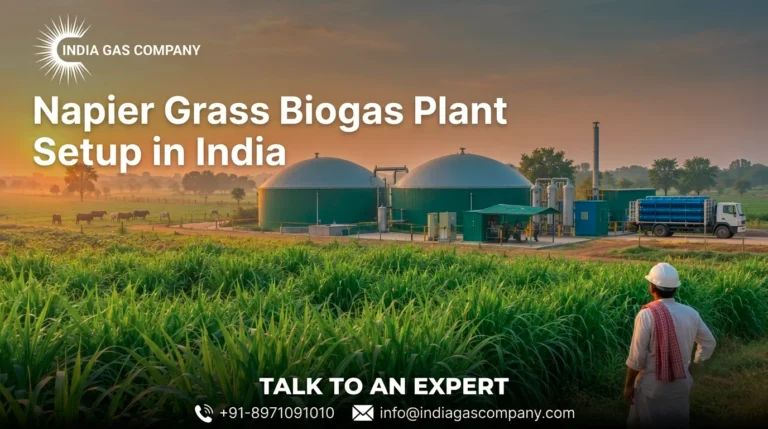

Why Napier Grass Is Becoming India’s Most Talked-About Biogas Feedstock
India is one of the world’s largest consumers of energy, and a large share of its natural gas, LPG and diesel is imported. At the same time, the country has millions of hectares of marginal and fallow land, a vast dairy sector, and a policy environment that increasingly rewards domestic, low-carbon fuels. Compressed Biogas (CBG), also called Bio-CNG, sits right at that intersection.
The biggest challenge for any biogas project is not the digester. It is feedstock security. Agricultural residue is seasonal and its price swings. Municipal waste is inconsistent. Cattle dung is excellent but limited by herd size. This is where Napier grass (Pennisetum purpureum), often called elephant grass, has emerged as a serious commercial answer.
Because Napier is a perennial, fast-growing, high-biomass crop, a plant developer can grow its own feedstock, contract it from farmers, or do both. That turns an uncertain waste-collection problem into a manageable agricultural supply chain.
In this guide, India Gas Company explains how a Napier grass biogas plant works, what to consider technically, how the economics are typically structured, and how industrial buyers, farmers, dairy owners and investors can approach their first project.
Planning a Napier-based biogas or Bio-CNG project? Talk to India Gas Company’s project team for a preliminary feasibility discussion. Contact details are at the end of this article.
What is Napier Grass and Why Does it Suit Biogas?
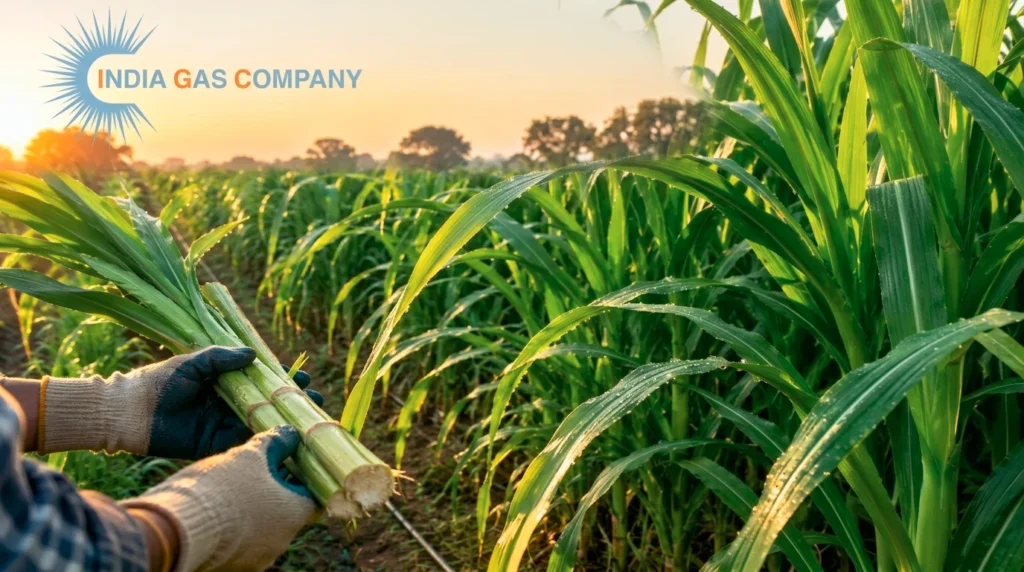
Napier grass is a tall, perennial tropical grass that has long been grown as fodder in India. Improved hybrids, commonly known as hybrid Napier or Bajra Napier Hybrid (BNH), and varieties such as CO-3, CO-4, CO-5 and Super Napier, have been bred for higher yield, softer stems and better regrowth. These are the types most commonly considered for energy use.
The features that make it attractive as a biogas feedstock include:
- High biomass yield. Under good irrigation and fertilization, hybrid varieties can produce very large green biomass volumes per hectare per year across multiple cuttings. Reported field yields vary widely by variety, soil, water and management, so any project should be planned on conservative, site-verified numbers.
- Perennial nature. One planting typically gives several years of harvests before replanting, which reduces recurring establishment cost.
- Multiple harvests. Cutting intervals of roughly 45 to 60 days, depending on climate, give a steady supply across the year in irrigated conditions.
- Adaptability. It grows across a wide range of soils and climates, including degraded and marginal land, though water availability strongly affects yield.
- Low input intensity relative to its output. Compared with many annual crops, it needs fewer operations per tonne produced.
- Predictable composition. A consistent, fibrous, carbohydrate-rich substrate is easier to design around than mixed waste.
- Ensilable. Napier can be stored as silage, which lets a plant run 365 days a year even when harvests are seasonal.
It is also worth noting that Napier is a non-food energy crop, which helps address food-versus-fuel concerns that apply to some other energy crops.
How much Biogas can Napier Grass Produce?
This is the question every investor asks first, so it is worth being careful and transparent.
Biogas output depends on the dry matter content, volatile solids (VS) content, the harvest stage, and how well the digester is managed. As a working planning range, fresh Napier grass at around 18 to 25 percent total solids can deliver roughly 55 to 80 cubic meters of biogas per ton of fresh feedstock, with methane content generally around 52 to 60 percent. Younger, leafier cuts usually digest better than older, woody growth.
Those figures should always be validated through a Biochemical Methane Potential (BMP) test on your actual variety and harvest schedule before financial closure.
A simple conversion to understand scale
A useful rule of thumb for planning: one tonne of CBG contains roughly 1,400 cubic metres of methane. Using the ranges above and allowing for process and upgrading losses, a plant typically needs on the order of 40 to 50 tonnes of fresh Napier grass to produce one ton of CBG. These are indicative planning numbers, not guarantees.
| Plant size (CBG) | Approx. fresh Napier needed per day | Approx. Napier needed per year | Indicative land if grown in-house* |
| 1 TPD | 40–50 tonnes | 14,600–18,250 tonnes | ~50–75 hectares |
| 2 TPD | 80–100 tonnes | 29,200–36,500 tonnes | ~100–150 hectares |
| 5 TPD | 200–250 tonnes | 73,000–91,250 tonnes | ~250–370 hectares |
Assuming roughly 250 tonnes per hectare per year of fresh biomass. Real yields vary considerably, so land requirements should be confirmed by an agronomic study.
This table highlights an important commercial point: feedstock logistics and land strategy determine whether a Napier project succeeds. Most developers use a mix of captive cultivation, contract farming and co-digestion with other substrates.
Business Models: Who Can Benefit and How
Napier-based biogas is not one-size-fits-all. Different stakeholders enter the value chain at different points.
1. Industrial buyers and fuel consumers
Factories using LPG, CNG, piped natural gas, furnace oil or diesel can explore Bio-CNG as a substitute fuel. Benefits include:
- Cleaner combustion and a lower carbon footprint, helpful for ESG reporting and export-market compliance
- Potential long-term price stability through a supply agreement, instead of exposure to volatile imported fuel prices
- Hedging against supply disruption
2. Agricultural entrepreneurs and farmer groups
Farmers can become feedstock suppliers to a central plant, or form a cooperative or farmer-producer organisation (FPO) that owns part of a project. Napier offers a recurring cash crop with a defined buyer, often on assured offtake contracts. Land that is unsuitable for food crops can be put to productive use.
3. Dairy farm owners
Dairy operations already generate daily dung, which is an ideal digester partner for Napier. Co-digesting the two improves stability and gas yield. Dairy farm owners can grow Napier for both fodder and energy, meet on-site electricity and heat needs, and monetise surplus gas or manure-derived products. Larger dairies and dairy cooperatives can also aggregate dung from surrounding farms to feed a shared plant.
4. Investors and project developers
For investors, a CBG plant is an infrastructure-style asset with multiple revenue lines: Bio-CNG sales, fermented organic manure (FOM), carbon credits where eligible, and in some designs captured CO₂. Policy backing and long-term energy demand improve the bankability, provided feedstock and offtake are properly contracted.
Looking for a bankable biogas investment structure? Request a preliminary project note from India Gas Company.
Technical Considerations for a Napier Grass Biogas Plant
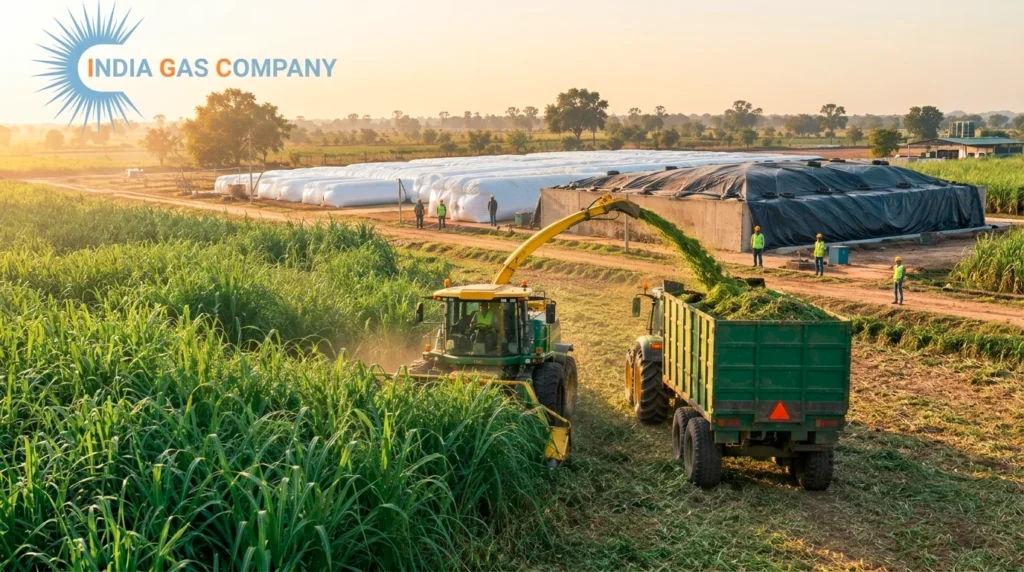
A successful plant is built on good engineering. Below are the key design areas that investors and operators should understand.
1. Feedstock cultivation and harvest planning
- Variety selection: Choose varieties proven in your agro-climatic zone and ask for reliable planting material (stem cuttings or root slips).
- Water and nutrients: Irrigation planning and nutrient management are the largest drivers of yield. Digestate returned to the field can reduce chemical fertiliser use.
- Harvest interval: Cutting too late increases lignin and lowers digestibility. Cutting too early reduces tonnage. The optimum is a balance, typically in the 45 to 60 day range depending on conditions.
- Harvest mechanisation: At commercial scale, mechanised harvesters and chaff cutters are essential to control labour cost and timeliness.
2. Pre-treatment and storage
- Size reduction: Chopping to a small particle size, commonly a few centimetres, increases surface area and speeds digestion.
- Ensiling: Storing chopped grass in silage bunkers or bags preserves energy content, evens out seasonal supply and, in many cases, improves digestibility.
- Contaminant control: Stones, soil and metal pieces must be removed to protect pumps, mixers and feeding systems.
3. Digester technology
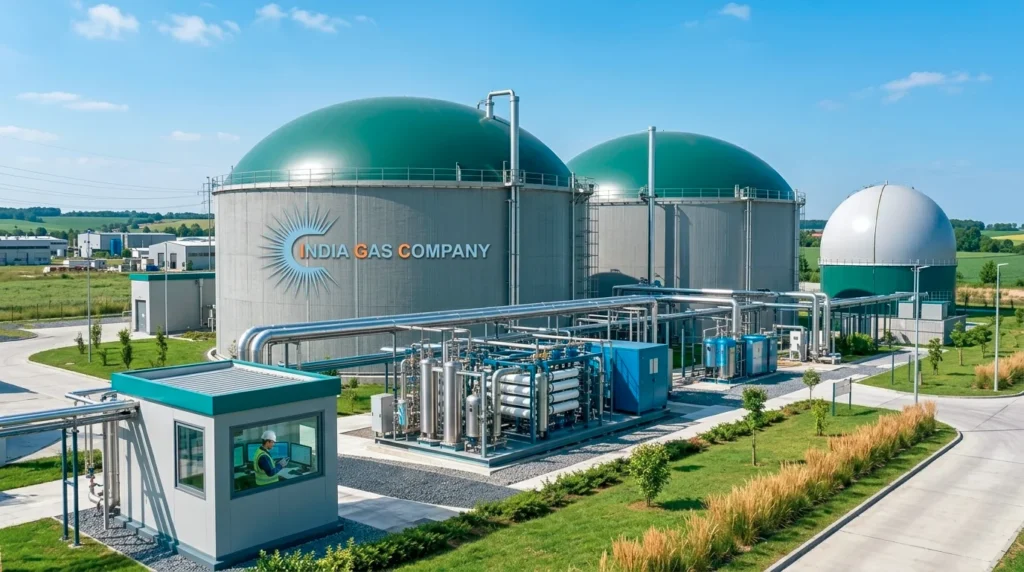
For fibrous energy crops, continuously stirred tank reactors (CSTR) operating in the mesophilic range (around 37 to 42 °C) are the most common choice. Key design variables include:
- Hydraulic retention time (HRT): Fibrous grass typically needs longer retention than easily digestible waste, often in the range of several weeks.
- Organic loading rate (OLR): Overloading causes acidification and process failure, so gradual ramp-up is critical.
- Mixing: Fibre can form floating crusts and cause dead zones. Properly designed agitators and feeding systems are essential.
- Feeding system: Reliable solid feeders or hoppers capable of handling fibrous material prevent downtime.
4. Co-digestion for stability
Grass is rich in carbon and relatively low in nitrogen. Co-digesting with cattle dung, poultry litter, pressmud, or other nitrogen-rich substrates balances the carbon-to-nitrogen ratio, buffers pH and supplies natural trace elements. Many successful Napier plants run a blend rather than grass alone.
5. Trace elements and process monitoring
Grass-heavy diets can become deficient in trace elements such as iron, cobalt, nickel and selenium. A good monitoring regime covers pH, volatile fatty acids to alkalinity ratio, ammonia, temperature, gas composition and biogas yield per tonne of feed. Early detection avoids costly digester upsets.
6. Biogas cleaning and upgrading
Raw biogas must be cleaned and upgraded to meet CBG quality norms for injection or dispensing:
- Desulphurisation to remove hydrogen sulphide
- Moisture removal and drying
- CO₂ separation using technologies such as membranes, pressure swing adsorption, or water or amine scrubbing
- Compression into cascades, typically at high pressure, for transport or dispensing
Technology choice affects methane recovery, energy consumption and operating cost, so it deserves careful evaluation.
7. Digestate management
Anaerobic digestion converts only part of the input mass into gas. The remainder is digestate, a nutrient-rich slurry that can be separated into solid and liquid fractions and processed into fermented organic manure (FOM) or liquid fertiliser. Good digestate handling is not an afterthought. It supports a second revenue stream and closes the nutrient loop back to the Napier fields.
8. Safety, statutory approvals and compliance
Plan early for consent to establish and operate from the State Pollution Control Board, electrical and gas safety approvals, explosives and pressure-vessel compliance where applicable, land-use permissions, and any requirements from the oil marketing company or gas distributor you plan to supply. A competent EPC partner will map these steps in advance.
Step-by-Step: Setting Up a Napier Grass Biogas Plant
- Define your objective. Decide whether you want on-farm energy, electricity generation, or a commercial Bio-CNG plant.
- Pre-feasibility study. Assess land, water, feedstock radius, offtake options and indicative returns.
- Feedstock strategy. Fix your mix of captive cultivation, contract farming and co-substrates. Sign farmer agreements early.
- BMP testing and agronomic trials. Validate the gas yield and biomass productivity of your chosen variety on your own soil.
- Detailed project report (DPR) and technology selection. Finalise capacity, digester design, upgrading technology and layout.
- Approvals, financing and offtake. Secure statutory clearances, lender sanction and a fuel offtake or purchase agreement.
- Plantation ramp-up. Begin cultivation well before commissioning so that feedstock is ready when the plant is.
- Construction and commissioning. Build, test and commission the plant, then ramp up feeding gradually.
- Operations and optimisation. Monitor yields, manage digestate, and continuously improve efficiency.
Need help with a DPR, BMP testing or plant design? Contact India Gas Company’s engineering team.
Understanding the Economics of a Napier-Based CBG Project
The financial model for a Napier project differs from a waste-based one in a few ways, because feedstock is a real cost, not a gate fee or a free by-product. That makes agronomy, logistics and yield discipline central to profitability.
Capital cost drivers
- Digesters, gas holders and mixing systems
- Feedstock receiving, chopping and silage infrastructure
- Gas cleaning, upgrading and compression
- Digestate handling and FOM processing
- Land development, irrigation and plantation (if captive)
- Utilities, civil works, safety systems and approvals
Capital cost per tonne per day of CBG capacity varies widely with scale, technology, location and scope, and it has moved over time. Rather than quoting a single figure, we recommend building a site-specific cost estimate through a DPR. As a general rule, larger plants spread fixed costs better, but they also need larger feedstock catchments.
Operating cost drivers
- Feedstock (cultivation and harvest, or purchase price and transport)
- Power and heat for the process
- Labour, maintenance and consumables
- Insurance, compliance and overheads
Revenue streams
| Revenue stream | Notes |
| Bio-CNG / CBG sales | The core revenue, typically sold to oil marketing companies, city gas distributors, or directly to industrial buyers under supply agreements |
| Fermented organic manure (FOM) | A sizeable by-product, with government market-development support available in some periods |
| Liquid fertiliser | Digestate liquid fraction for nearby farms |
| Carbon credits | Possible where methodology and registration requirements are met |
| Captured CO₂ | Potential sale to food, beverage or industrial users where a market exists |
What drives ROI?
The main levers are feedstock cost per tonne, biomass yield per hectare, biogas yield per tonne, plant uptime, CBG realisation price, and FOM monetisation. A project that is conservative on yield assumptions, secures long-term offtake, and treats digestate as a product rather than waste is far better placed to hit its targets. Payback periods vary by structure and incentives, and should be modelled for each project instead of assumed.
Policy and Incentive Landscape in India
India has built a supportive framework for bio-energy. The details change periodically, so always confirm current terms before committing capital. Key pillars include:
- SATAT (Sustainable Alternative Towards Affordable Transportation): Launched by the Ministry of Petroleum and Natural Gas, it invites entrepreneurs to produce CBG and sell it to oil marketing companies under long-term offtake arrangements.
- GOBARdhan: A national initiative to convert cattle dung and organic waste into biogas, bio-manure and related products, relevant especially for dairy and rural projects.
- National Bio-Energy Programme (MNRE): Provides central financial assistance for eligible biogas and bio-energy projects.
- Compressed Biogas Blending Obligation: A phased mandate on gas marketers and distributors to blend CBG, creating structural demand.
- Market development support for FOM: Aimed at encouraging the use of organic manure produced from biogas plants.
- Priority-sector and concessional financing: Renewable energy projects may qualify for easier access to bank credit and development-finance schemes.
- Waste-to-energy and land-related support: Several states offer additional incentives, land concessions or fast-track approvals.
Because these programmes are updated frequently, a good advisor will map the central and state-level benefits that apply to your specific project.
Key Risks and How to Manage Them
A credible article should be honest about risk. The most common issues with grass-based biogas projects are:
| Risk | Mitigation |
| Lower-than-expected biomass yield | Run field trials, choose proven varieties, invest in irrigation and nutrition |
| Feedstock price volatility or farmer side-selling | Use multi-year contracts with fair price formulas, fixed delivery schedules and advance support |
| Seasonality and storage losses | Build adequate silage capacity and follow best-practice ensiling |
| Digester acidification or foaming | Gradual loading, co-digestion, trace-element dosing and regular lab monitoring |
| Fibre handling and equipment wear | Select suitable feeders, pumps and mixers, and keep spares |
| Offtake or price uncertainty | Secure long-term purchase agreements before financial closure |
| Digestate disposal or low FOM demand | Plan application on own fields and develop buyer relationships early |
| Regulatory change | Work with advisors who track policy and structure contracts with change-in-law provisions |
Managing these risks is less about eliminating them and more about designing the project so that no single failure sinks it.
Special Considerations for Dairy Farm Owners
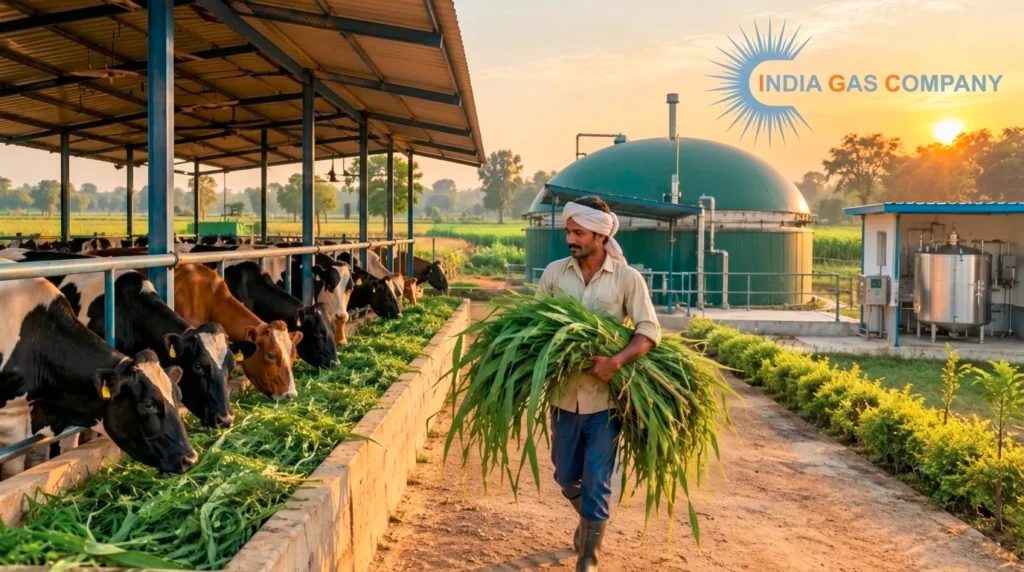
If you own a dairy, you may already hold half of the solution. A few practical points:
- Start with dung, add grass strategically. Use cattle dung as the base and add Napier to raise gas output per digester volume.
- Grow your own fodder and energy crop. Napier can serve double duty, supplying quality green fodder and feeding the digester.
- Use biogas on site. Electricity for chilling, milking and cooling, and heat for hot-water needs, can reduce operating costs quickly.
- Use digestate as fertiliser. Returning nutrients to the soil reduces input bills and completes the circular loop.
- Consider scale. Very small herds may be better served by small-scale biogas units, while larger dairies or clusters can justify a commercial CBG plant.
Own a dairy farm and want to evaluate biogas? Ask India Gas Company for a farm-level assessment.
Why Industrial Buyers Should Consider Bio-CNG
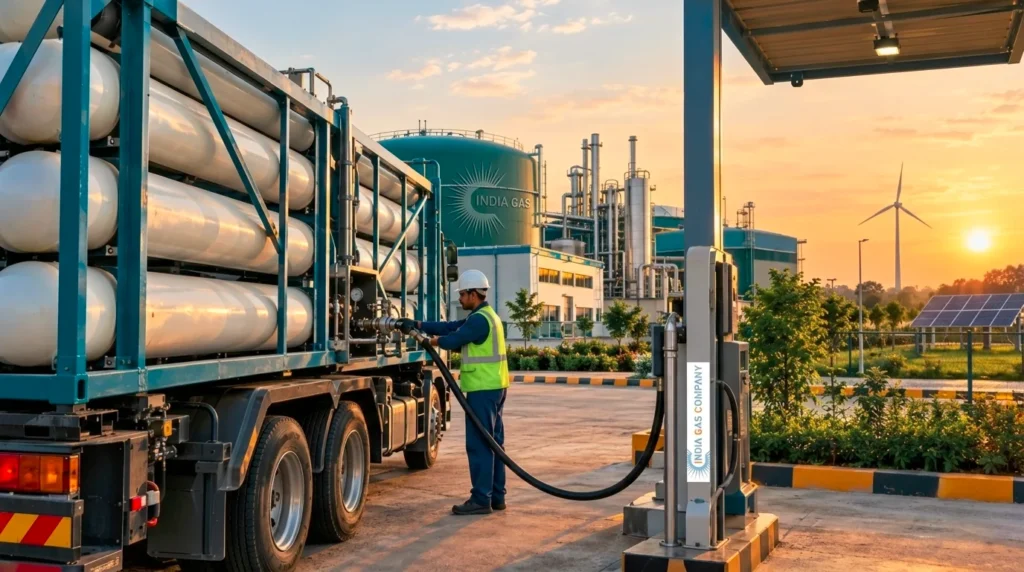
For manufacturers, food processors, textile units, ceramics and glass plants, and logistics operators, Bio-CNG offers a practical decarbonisation route:
- Drop-in compatibility: Upgraded biogas is chemically similar to natural gas and works with CNG-compatible equipment.
- Scope 1 and Scope 2 emission reduction: Biogenic fuels can support sustainability and net-zero commitments.
- Supply security: A domestic fuel reduces dependence on imports and global price swings.
- Brand and compliance value: Increasingly relevant for exporters facing carbon-related buyer requirements.
If you are an industrial consumer, you can either buy CBG from a plant, sign a long-term supply agreement, or take an equity position in a dedicated project.
Environmental and Social Benefits
Beyond financial returns, Napier-based biogas offers wider value:
- Rural employment in cultivation, harvesting, transport and plant operations
- Productive use of marginal land
- Reduced stubble and waste burning when combined with residue-based substrates
- Lower methane emissions from managed manure compared with open storage
- Lower dependence on chemical fertilisers through digestate use
- Cleaner cooking and transport fuel options for communities
Napier also has good root structure that can help reduce soil erosion in suitable settings, although it should be planted thoughtfully to avoid unwanted spread outside managed fields.
Napier Grass Biogas Plant Setup in India – FAQs
-
How much does a Napier grass biogas plant cost in India?
Cost depends on capacity, technology, location, feedstock arrangements and scope (power versus CBG, captive land versus contracted supply). A reliable number comes only from a site-specific detailed project report. India Gas Company can help you build a realistic estimate.
-
How much land do I need to grow Napier grass for a biogas plant?
It depends on plant size and your realised yield. As a rough indication, a 1 TPD CBG plant may need several tens of hectares of well-managed Napier if fully captive, but many projects combine in-house cultivation with contract farming and co-substrates.
-
Is Napier grass better than cow dung for biogas?
They serve different roles. Napier offers higher energy density per tonne and controllable supply, while dung provides process stability and nutrients. Most commercial plants use both.
-
Can Napier grass be used for electricity as well as Bio-CNG?
Yes. Biogas from Napier can run a gas engine for power and heat, or be upgraded into CBG. The right route depends on your energy needs, grid access and offtake prices.
-
How long does it take to commission a biogas plant?
Timelines vary with approvals, financing and plantation readiness. Many developers plan for the plantation to be established well before plant commissioning, which can be the longest lead item.
-
What are the most common reasons biogas plants underperform?
Underestimated feedstock logistics, unrealistic yield assumptions, poor digester design for fibrous material, weak process monitoring and lack of offtake clarity.
-
Can small farmers participate without owning a plant?
Yes. Farmers can supply Napier under contract, join an FPO, or take part in cluster models, earning recurring income without carrying plant operating risk.
Why Work with India Gas Company?
Setting up a Napier-based biogas project involves agronomy, process engineering, gas upgrading, finance and regulation, all at once. India Gas Company supports clients across the project journey, including:
- Feasibility studies and site assessment
- Feedstock planning and contract-farming models
- Plant design, technology selection and EPC support
- Commissioning, operations support and optimization
- Guidance on offtake agreements, incentives and compliance
Our goal is simple: to help you build a project that is technically sound, commercially realistic and built to last.
Conclusion: Turning Grass into a Reliable Energy Business
Napier grass gives the biogas industry something it has long needed: a scalable, plannable, domestically grown feedstock. For industrial buyers, it offers a path to cleaner, more secure fuel. For farmers and dairy owners, it opens a new income stream and a smarter use of land. For investors, it presents a policy-supported opportunity in India’s growing bio-energy market.
The projects that succeed will be those that respect the fundamentals: conservative yield assumptions, strong feedstock contracts, robust digester design, a clear offtake and a plan for digestate. Get these right, and a field of grass can become a long-term energy asset.
Get Started with India Gas Company
Ready to explore a Napier grass biogas or Bio-CNG project?
- Request a free pre-feasibility discussion with our project experts
- Get a customized project estimate for your land, herd or industrial requirement
- Call: +91-8971091010
- Email: info@indiagascompany.com
- Website: https://indiagascompany.com
India Gas Company: Powering India’s renewable energy future, one project at a time.
Disclaimer: Figures in this article, including biogas yield, feedstock requirements and land estimates, are indicative planning values that vary with variety, climate, management and technology. Policy details and incentives change from time to time. Please validate all numbers through site-specific studies and current official sources before making investment decisions.
You May Also Like:
🔗 Top Biogas Manufacturer in India: Complete Guide to Biogas Plants and EPC Solutions
🔗 CNG Plant Setup: Types, Capacity, Cost & Applications