
The Overlooked Revenue Stream in Every Biogas Plant
Every biogas plant produces two valuable gases, but most operators monetise only one.
Raw biogas from anaerobic digestion typically contains 50–65% methane (CH₄) and 35–45% carbon dioxide (CO2), along with small amounts of hydrogen sulphide (H₂S), moisture, nitrogen and trace compounds. The methane is upgraded into bio-CNG or compressed biogas (CBG) and sold as clean fuel. The CO2 is commonly vented into the atmosphere.
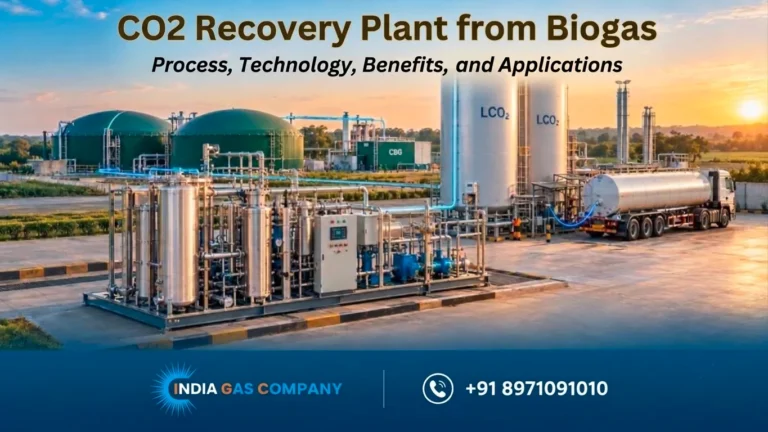
That is a missed opportunity. A CO2 recovery plant from biogas captures this stream, purifies it to food-grade or industrial-grade quality, liquefies it, and turns it into a saleable product. It adds revenue and improves project economics. It also reduces the plant’s carbon footprint and supports the circular economy.
At India Gas Company, we design and supply CO2 recovery plants for biogas, CBG, landfill gas and fermentation-based projects. This guide explains how biogas CO2 recovery works, which technologies are used, what it delivers financially and environmentally, and how to choose the right system. It is written for CBG plant developers, distillery owners, dairy and food processors, industrial gas distributors, EPC contractors and investors in India and abroad.
What is a CO2 Recovery Plant from Biogas?
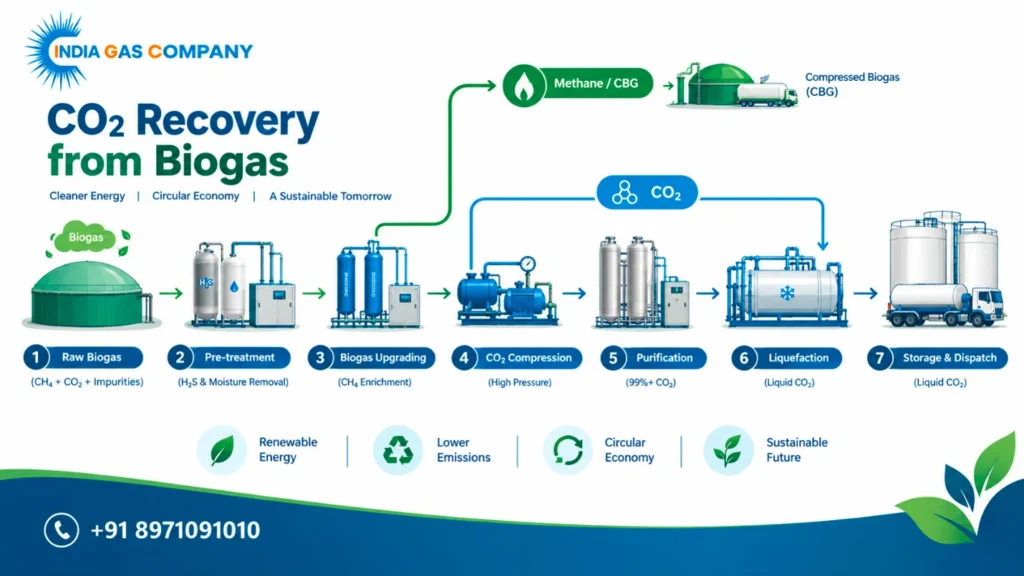
A CO2 recovery plant from biogas is an integrated system that captures the carbon dioxide separated during biogas upgrading and processes it into high-purity liquid CO2 (typically 99.9% or higher) or other CO2 products such as dry ice.
It is usually installed downstream of a biogas upgrading plant. The upgrading unit separates methane from CO2, and the recovery plant then:
- Collects the CO2-rich off-gas (the “tail gas” or “permeate”) from the upgrader.
- Removes impurities such as moisture, Sulphur compounds, residual methane, volatile organic compounds (VOCs) and oxygen.
- Compresses, dries, purifies and liquefies the CO2.
- Stores it in insulated tanks for sale in bulk or cylinders.
The result is a commercial-grade gas that can be sold to beverage companies, food processors, welding gas distributors, greenhouse growers, chemical manufacturers and many other industries.
Why CO2 Recovery from Biogas Matters Now
The growth of biogas and CBG in India
India’s push toward clean energy has created rapid growth in biogas and compressed biogas. Government initiatives such as the SATAT scheme (Sustainable Alternative Towards Affordable Transportation), the GOBARdhan programme, the National Bioenergy Programme and phased CBG blending obligations for city gas distribution and transport fuel are driving large-scale investment in CBG plants across the country. Each plant that upgrades biogas to CBG generates a large stream of CO2 as a by-product.
Rising demand for CO2 in India and globally
Demand for CO2 keeps growing in beverages, packaged food, cold-chain logistics, healthcare, agriculture and industrial manufacturing. Much of the industrial CO2 supply has historically depended on fossil-linked sources such as ammonia and hydrogen plants or natural CO2 wells. Biogenic CO2 gives buyers a renewable, traceable alternative, and many corporates now look for it to meet sustainability targets.
Sustainability and ESG pressure
Venting CO2 from biogas upgrading releases biogenic carbon back into the atmosphere. Capturing and using it improves a project’s environmental profile and supports ESG reporting, carbon-reduction commitments and sustainability-linked financing.
In short, a CO2 recovery plant helps a biogas business become more profitable, more sustainable and more competitive.
Composition of Biogas and Where the CO2 Comes From
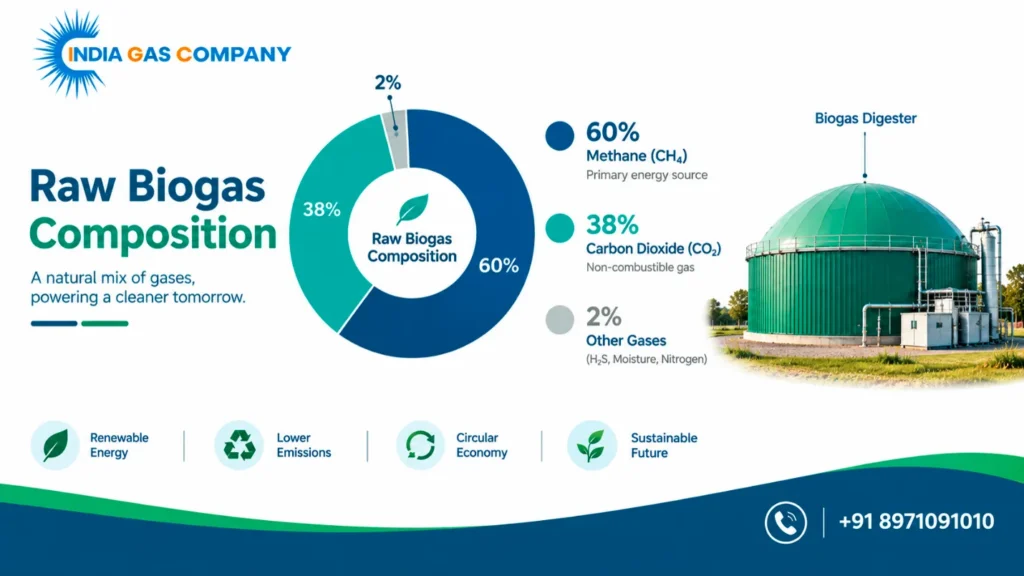
Understanding the feed gas explains why recovery is both feasible and valuable.
| Component | Typical Range in Raw Biogas |
| Methane (CH₄) | 50–65% |
| Carbon dioxide (CO2) | 35–45% |
| Hydrogen sulphide (H₂S) | 50–5,000+ ppm |
| Moisture (H₂O) | Saturated |
| Nitrogen / Oxygen | Small percentages |
| Siloxanes / VOCs | Trace (more in landfill gas) |
The exact composition depends on the feedstock: cattle dung, press mud, distillery spent wash, municipal solid waste, agricultural residue, napier grass, food waste or sewage sludge. The feedstock also determines how much pre-treatment is needed before CO2 can be recovered at food-grade purity.
A typical CBG plant processing 1,000 Nm³/hr of raw biogas can generate several hundred kilograms of CO2 per hour. Annualised, that is thousands of tonnes of CO2 that can be sold rather than vented.
The Process: How CO2 is Recovered from Biogas, Step by Step
Every installation is customized, but a well-designed biogas CO2 recovery plant follows this general sequence.
Step 1: Biogas Pre-Treatment
Raw biogas is first cleaned of contaminants that would damage downstream equipment or compromise CO2 purity:
- H₂S removal through biological desulphurisation, iron-based scavengers or activated carbon.
- Moisture removal through chillers, condensers and dryers.
- Siloxane and VOC removal through activated carbon beds, mainly for landfill and sewage gas.
- Particulate filtration to protect compressors and membranes.
Step 2: Biogas Upgrading (CH₄/CO2 Separation)
The cleaned biogas passes through an upgrading technology that separates methane from carbon dioxide. Common options include membrane separation, amine scrubbing, pressure swing adsorption (PSA) and water scrubbing. The methane-rich product becomes bio-CNG, while the CO2-rich stream is directed to the recovery section. (Technology choices are covered in detail below.)
Step 3: CO2 Stream Collection and Compression
The CO2-rich off-gas is collected and compressed, typically to 15–25 bar, depending on the downstream liquefaction design. Oil-free compressors are preferred to preserve purity for food-grade applications.
Step 4: Purification and Polishing
This is the most critical stage for achieving food-grade quality. Purification usually includes:
- Catalytic oxidation or methane recovery to remove residual methane and recycle it, which also improves methane yield.
- Activated carbon filtration to remove odour compounds and trace organics.
- Sulphur polishing to remove residual H₂S and other sulphur compounds.
- Dehydration using molecular sieve or silica gel dryers to achieve very low moisture.
- Stripping of non-condensable such as nitrogen, oxygen and remaining light gases in a distillation or stripper column.
Step 5: CO2 Liquefaction
The purified CO2 is cooled and condensed into liquid form using a refrigeration system, typically at around −20 to −30 °C and 16–20 bar. A CO2 liquefaction plant converts the gas into a dense liquid that is far easier and cheaper to store and transport.
Step 6: Storage and Dispatch
Liquid CO2 is stored in vacuum-insulated or refrigerated storage tanks. It can then be dispatched in bulk tankers, filled into cylinders, or converted into dry ice. Automated controls, level monitoring and safety systems ensure reliable and safe operation.
Technologies Used in Biogas CO2 Recovery
Selecting the right technology combination is central to project success. Below is a practical comparison of the major options.
1. Amine Scrubbing (Chemical Absorption)
Amine scrubbing uses a solvent, usually an amine solution, that chemically absorbs CO2 from biogas at low pressure. The CO2 is later released by heating (regeneration), producing a very pure, high-concentration CO2 stream.
Advantages
- Very high methane recovery (typically above 99.5%).
- Produces near-pure CO2 directly, which makes recovery simpler.
- Low methane slip, so environmental performance is excellent.
- Works well at near-atmospheric pressure.
Considerations
- Requires heat for solvent regeneration, so access to waste heat or steam helps.
- Solvent management and periodic replacement are needed.
Amine-based upgrading is often the preferred pairing for a food grade CO2 plant because the captured CO2 is already highly concentrated.
2. Membrane Separation
Membrane systems use selective polymer membranes. CO2 permeates through the membrane faster than methane, creating a methane-rich retentate and a CO2-rich permeate.
Advantages
- Compact, modular and easy to scale.
- Low operating complexity and quick start-up.
- No chemicals or water consumption.
Considerations
- The permeate contains some methane, so a methane recovery step (catalytic oxidiser or multi-stage membranes) is needed before CO2 liquefaction.
- Performance depends on feed quality and proper pre-treatment.
Membrane-based upgrading combined with a downstream CO2 purification and liquefaction unit is very popular in India and other emerging markets.
3. Pressure Swing Adsorption (PSA)
PSA uses adsorbent materials such as carbon molecular sieves or zeolites to selectively capture CO2 under pressure and release it when the pressure drops.
Advantages
- No liquid chemicals needed.
- Moderate energy use and a well-established technology.
Considerations
- Tail gas contains methane and requires treatment before the CO2 is purified.
- More complex valve sequencing and control.
4. Water Scrubbing
Water scrubbing exploits the higher solubility of CO2 in water under pressure. CO2 is stripped from the water in a desorption column.
Advantages
- Simple and robust, with no special chemicals.
- Handles feed gas variations reasonably well.
Considerations
- High water and power demand; methane slip can be higher.
- Dissolved gases require careful management for CO2 purity.
5. Cryogenic and Hybrid Systems
Cryogenic upgrading cools biogas to very low temperatures so CO2 condenses or solidifies and separates from methane. It can deliver liquid CO2 and high-purity bio-methane in one integrated process.
Advantages
- Produces liquid CO2 and methane directly.
- High purity potential for both products.
Considerations
- Higher capital cost and process complexity.
- Best suited to larger projects or specific high-value scenarios.
Which technology is right for you?
There is no universal answer. The best choice depends on:
- Biogas flow rate and composition
- Feedstock type and seasonal variation
- Target CO2 purity and standards
- Availability of heat, power and water
- Local CO2 demand and logistics
- Capital budget and return-on-investment goals
India Gas Company engineers evaluate these factors to recommend the most cost-effective CO2 recovery plant configuration for each client.
Food-Grade CO2 Quality: Standards That Matter
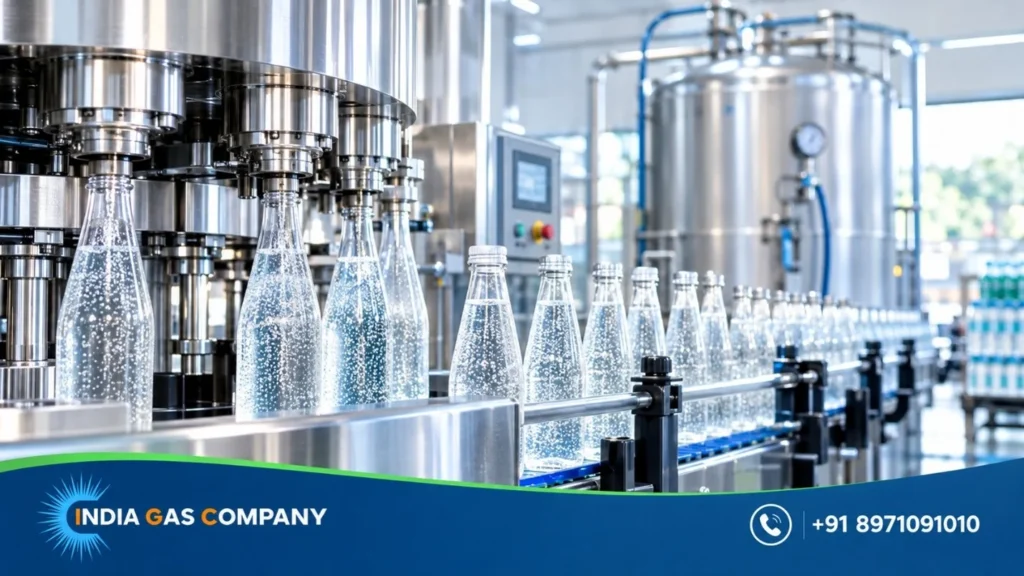
If you plan to sell to the beverage or food industry, purity and compliance are non-negotiable. A high-quality food grade CO2 plant should deliver:
- CO2 purity: typically ≥ 99.9% (v/v)
- Very low moisture: commonly ≤ 20 ppm
- Very low oxygen, hydrocarbons, sulphur compounds, benzene and other contaminants
- Compliance with recognised benchmarks such as ISBT (International Society of Beverage Technologists) guidelines, EIGA (European Industrial Gases Association) specifications and applicable FSSAI and local food-safety requirements
Because biogas is a biogenic source, the impurity profile differs from that of ammonia-plant or fermentation CO2. This makes proper purification design, analytical monitoring and quality control essential. Our plants are engineered with multi-stage purification, online analysers and sampling provisions so that the CO2 you produce can meet buyer specifications consistently.
Key Benefits of Installing a CO2 Recovery Plant from Biogas
1. New Revenue Stream
The most compelling benefit is financial. Liquid CO2 is a traded commodity with steady industrial demand. Selling it alongside CBG or bio-methane can improve the plant’s overall profitability and shorten the payback period of the whole biogas project. In many cases, the incremental revenue from CO2 meaningfully improves margins compared with a CBG-only business model.
2. Better Project Economics and Bankability
Diversified revenue lowers risk. Lenders and investors look favourably on projects with multiple income streams, especially when one is tied to a stable industrial customer base.
3. Reduced Carbon Footprint
Capturing biogenic CO2 instead of venting it supports decarbonisation goals. Supplying it to industry can displace fossil-derived CO2, strengthening the sustainability credentials of both producer and buyer.
4. Higher Methane Recovery
Many CO2 recovery configurations include methane recovery from the CO2-rich tail gas. This minimises methane slip, which is a more potent greenhouse gas than CO2, and increases the quantity of saleable CBG.
5. Support for the Circular Economy
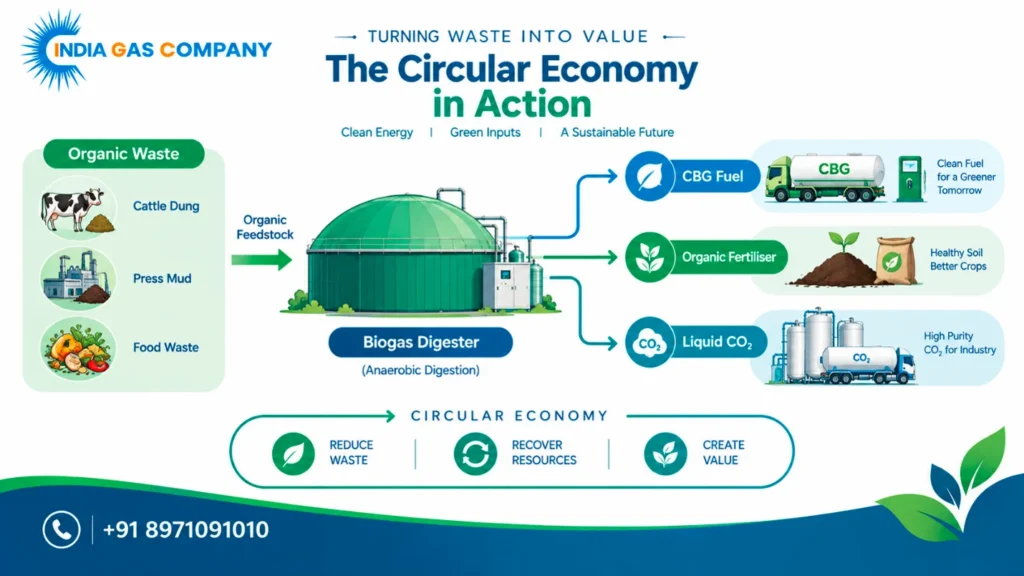
Organic waste becomes fuel, fertilizer (digestate or fermented organic manure) and CO2. This is a clear example of waste valorization, and it positions your plant as a complete resource-recovery facility.
6. Local Supply and Lower Logistics Cost for Customers
Many beverage bottlers, food processors and industrial users currently receive CO2 from distant sources. A locally produced supply from a biogas plant can reduce transport distance, improve availability and offer more stable pricing for nearby customers.
7. Regulatory and Policy Alignment
Environmental regulations and corporate sustainability reporting are tightening in India and worldwide. A CO2 recovery system helps projects align with emission-reduction expectations and clean-energy policy goals.
8. Modular, Scalable Investment
Plants can be designed in modular capacities and expanded as biogas production grows, so you can start with a size suited to today’s volumes and scale up as the business matures.
Applications of Recovered CO2 from Biogas
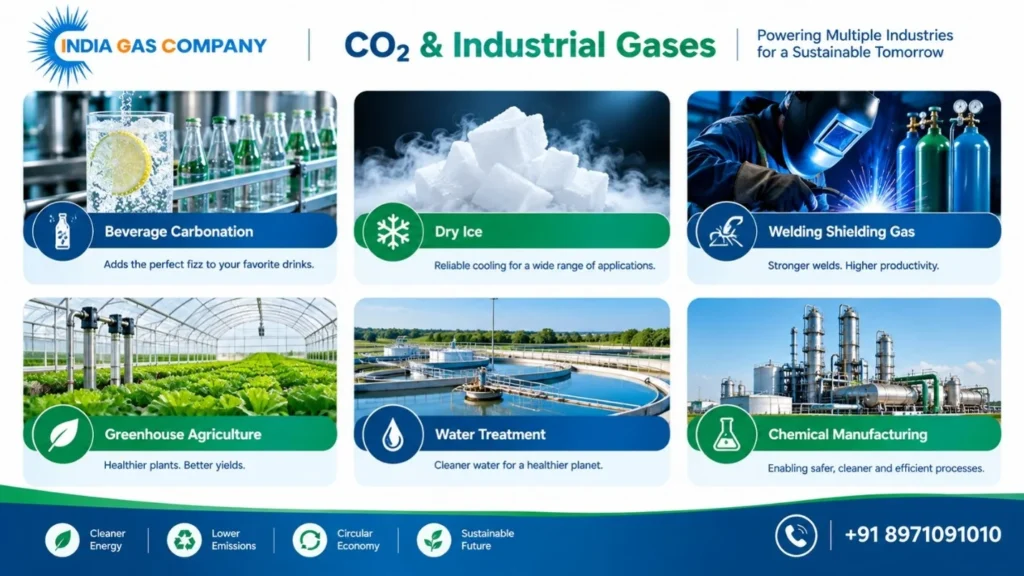
The versatility of liquid CO2 is a major reason this business works. Typical end-use sectors include:
Food and Beverage Industry
- Carbonation of soft drinks, sparkling water, beer and other beverages
- Modified atmosphere packaging (MAP) to extend shelf life
- Chilling and freezing of food products
- Decaffeination and extraction processes
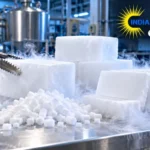
Dry Ice Production
- Cold-chain logistics for pharmaceuticals, vaccines, seafood and ice cream
- Industrial cleaning (dry ice blasting)
- Event, hospitality and entertainment applications
Our systems can be integrated with dry ice production units so you can sell higher-margin products.
Welding and Metal Fabrication
- Shielding gas mixtures (for example with argon) in MIG/MAG welding
Agriculture and Greenhouse Cultivation
- CO2 enrichment to boost yield and quality of vegetables, flowers and horticultural crops
- Soil and water pH management
Water Treatment
- pH control and neutralization of alkaline water and effluents, replacing stronger mineral acids and improving safety
Chemical and Industrial Uses
- Production of urea, methanol, polycarbonates, sodium bicarbonate, carbonates and other chemicals
- Fire-suppression systems and extinguishers
- Supercritical CO2 extraction (for example in nutraceuticals and flavours)
Emerging and Future Applications
- Feedstock for e-fuels and e-methanol, combining biogenic CO2 with green hydrogen
- Algae cultivation and carbon utilization technologies
- Carbon-negative building materials and mineralization
- Enhanced oil recovery and carbon storage, where permitted and viable
Because these end markets are diverse, plant owners are not dependent on a single customer type, which helps stabilize revenue.
Who Should Invest in a CO2 Recovery Plant?
A biogas CO2 recovery system suits many types of businesses:
- CBG and bio-CNG plant developers who want to improve project returns
- Distilleries and sugar mills with large biogas or fermentation streams
- Dairy, poultry and agro-industry operators running biogas digesters
- Municipal solid waste and sewage treatment operators upgrading landfill or sewage gas
- Industrial gas companies and CO2 distributors seeking renewable supply sources
- Beverage and food manufacturers exploring captive CO2 supply for energy security and sustainability
- EPC companies, project developers and investors building biogas portfolios in India, South Asia, the Middle East, Africa, Southeast Asia and beyond
Design Considerations Before You Invest
A successful project starts with careful planning. Key factors our team reviews with clients include:
- Biogas volume and consistency: Stable feed gas flow improves both efficiency and economics.
- Gas composition: H₂S, siloxane, VOC and oxygen levels influence pre-treatment and purification needs.
- Market assessment: Identify nearby CO2 buyers, expected price ranges, delivery distances and contract potential before sizing the plant.
- Purity target: Food-grade requirements demand a more elaborate purification train than technical-grade CO2.
- Utilities: Power, cooling water, instrument air and (for amine systems) heat availability.
- Storage and logistics: Tank size, filling stations, tanker access and cylinder-filling arrangements.
- Safety and compliance: Pressure vessel codes, gas-handling regulations, explosion-protection (ATEX or equivalent) and statutory approvals.
- Automation: PLC/SCADA control, remote monitoring and data logging to ensure consistent quality and lower operating costs.
- Space and layout: Compact skid-mounted designs reduce civil work and installation time.
- Lifecycle costs: Evaluate energy consumption, consumables, maintenance and spare-part availability, not just upfront price.
Economics: How Does the Business Case Work?
While every project differs, the economics of a CO2 recovery plant from biogas generally depend on four variables:
- CO2 production volume (tonnes per day or per year)
- Selling price of liquid CO2 in your region and customer segment
- Capital and operating costs (power, refrigeration, consumables, manpower, logistics)
- Utilisation and uptime of the plant
Because the CO2 is already being separated during upgrading, the incremental cost of recovery is often substantially lower than building a standalone CO2 production facility. Combined with a reliable offtake agreement, the investment can deliver an attractive payback. India Gas Company can help you prepare a preliminary techno-commercial estimate tailored to your biogas flow rate and local market.
Why Choose India Gas Company as Your CO2 Recovery Plant Manufacturer?
Choosing the right partner is as important as choosing the right technology. When you work with India Gas Company, you benefit from:
- Application-specific engineering: Every CO2 plant is designed around your gas composition, capacity and end-use requirements, not a generic template.
- End-to-end solutions: From feasibility study and process design to supply, installation, commissioning, training and after-sales service.
- Integration expertise: Seamless integration with your existing or planned biogas upgrading plant, CBG plant or fermentation facility.
- Food-grade focus: Multi-stage purification and quality-control systems built to meet demanding beverage and food standards.
- Energy-efficient design: Optimised compression, refrigeration and heat-recovery to keep operating costs low.
- Modular, skid-mounted systems: Faster deployment, easier scalability and reduced site work.
- Robust automation and safety: PLC-based control, interlocks, alarms and monitoring for dependable operation.
- Support for domestic and international projects: We understand Indian regulations, climate and market conditions, and we support export projects with documentation, logistics and technical guidance for international clients.
- Reliable service and spares: Responsive technical support, preventive maintenance programmes and ready availability of critical spares to maximise uptime.
Opportunities for International Clients
Biogas and biomethane markets are expanding well beyond India. Europe, North America, the Middle East, Africa, Southeast Asia and Latin America are all investing in renewable gas and in capturing biogenic CO2.
International customers choose India Gas Company because we offer:
- Competitive pricing without compromising on engineering quality
- Plants configured for different climates, voltage standards and regulatory frameworks
- Remote commissioning and monitoring support
- Documentation and quality assurance suited to global project requirements
- A flexible approach to capacity, from small farm-scale systems to large industrial installations
If you are developing a biogas project in a new market, our team can help you evaluate biogas to CO2 monetization from the earliest design stage.
Implementation Roadmap: From Idea to Operating Plant
A typical project with India Gas Company follows these stages:
- Enquiry and data collection: Share your biogas flow, composition, location and business goals.
- Feasibility and techno-commercial proposal: We recommend the most suitable process configuration and provide capacity, utility and cost estimates.
- Detailed engineering: Process design, P&IDs, equipment selection, layout and safety studies.
- Manufacturing and quality checks: Skid fabrication, testing and inspection.
- Delivery and installation: Dispatch, site installation and integration with your biogas system.
- Commissioning and training: Performance testing, product-quality validation and operator training.
- After-sales support: Maintenance programmes, spares supply and technical assistance for the life of the plant.
Frequently Asked Questions (FAQs)
1. What is a CO2 Recovery Plant from Biogas?
It is a system that captures carbon dioxide from the biogas upgrading process, purifies it and liquefies it so it can be sold as food-grade or industrial-grade CO2 instead of being released into the atmosphere.
2. How much CO2 can I recover from my Biogas Plant?
Raw biogas typically contains 35–45% CO2, and most of it can be recovered in a properly designed system. The exact quantity depends on your biogas flow rate, composition and the chosen technology.
3. Can CO2 from Biogas be used in Food and Beverages?
Yes, provided it is purified to meet food-grade standards such as ISBT and EIGA benchmarks. A well-designed food grade CO2 plant with proper purification and quality control can supply beverage and food companies.
4. Which technology is best for Biogas CO2 Recovery?
It depends on your project. Amine scrubbing gives very pure CO2 and high methane recovery, membranes are compact and modular, and PSA and water scrubbing suit specific conditions. Our engineers recommend the best option after studying your gas and business goals.
5. Is a CO2 recovery plant suitable for small and medium Biogas Projects?
Yes. Modular and skid-mounted designs allow even small and mid-sized CBG and biogas plants to evaluate CO2 recovery, subject to feasibility and available CO2 demand.
6. What is the typical payback period?
This varies with plant capacity, local CO2 prices, operating costs and market demand. We provide a project-specific estimate once we understand your parameters.
7. Do you supply CO2 recovery plants outside India?
Yes. India Gas Company supports clients across Asia, the Middle East, Africa and other regions, with engineering, documentation and technical support for export projects.
8. Can the plant also produce dry ice?
Yes. Liquid CO2 from the plant can be routed to a dry ice production unit to serve cold-chain, cleaning and industrial customers.
9. Does CO2 recovery affect my CBG output?
Properly integrated, it does not reduce CBG output. With methane recovery from the tail gas, it can actually increase usable methane and improve overall plant efficiency.
10. What after-sales support do you offer?
We offer commissioning, operator training, preventive maintenance, spares supply and ongoing technical assistance.
Conclusion: Turn Your Biogas CO2 into Profit
A biogas plant does not have to stop at methane. With a modern CO2 recovery plant, the carbon dioxide you currently vent becomes a valuable, sellable product. It strengthens your business case, reduces emissions, and connects your plant to the beverage, food, agriculture, welding and chemical industries.
Whether you are building a new CBG facility, expanding an existing biogas project, or looking to secure a renewable CO2 supply, the right technology partner makes the difference between a good project and an excellent one.
India Gas Company offers proven engineering, quality-focused manufacturing and dependable service for CO2 recovery from biogas, delivered to clients across India and around the world.
Ready to Monetize Your Biogas CO2?
Contact India Gas Company today.
For a free consultation and customized proposal.
☎ +91-8971091010
📩 info@indiagascompany.com
🌐 www.indiagascompany.com
Share your biogas flow rate, composition and location, and our engineers will recommend the best CO2 recovery plant configuration for your project.
You May Also Like:
🔗 Biogas Plant Cost in India: Equipment & Installation Guide
🔗 Napier Grass Biogas Plant Setup in India: A Complete Commercial Guide