
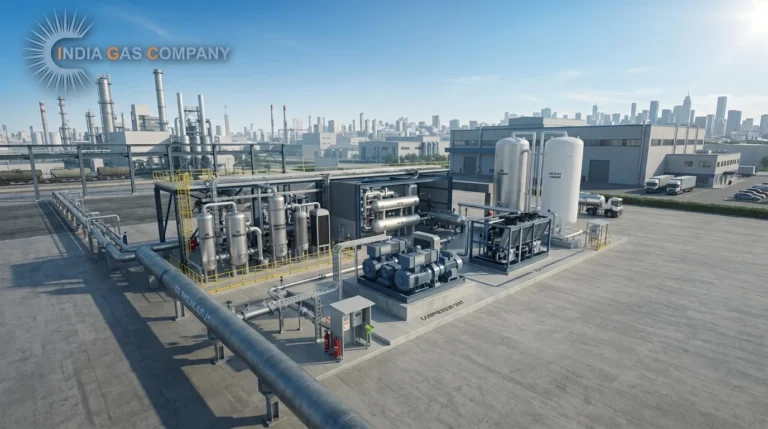

Carbon dioxide is no longer viewed only as an unavoidable by-product of industrial processes. With the right technology, CO₂ can be recovered, purified, compressed, liquefied, stored, and supplied as a valuable industrial gas.
For industries that generate CO₂-rich gas streams, a well-designed recovery facility can reduce dependence on external CO₂ suppliers while creating an opportunity to convert a waste or by-product stream into a usable commercial resource.
A CO2 recovery plant is designed to capture carbon dioxide from a suitable gas source, remove contaminants, dry and purify the gas, compress it, and, depending on the application, convert it into liquid CO₂ or another usable form.
The exact process configuration depends on the source gas, CO₂ concentration, required purity, production capacity, pressure, temperature, and end-use application.
For companies considering a new CO₂ recovery project, choosing the right technology and engineering partner is as important as selecting individual equipment.
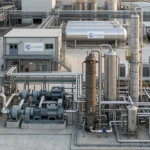
A plant may contain compressors, purification equipment, dryers, refrigeration systems, storage tanks, pumps, control systems, and safety equipment, but these components must work together as an integrated system.
Planning a CO₂ Recovery Plant? Start With a Project Assessment
If your company is generating a CO₂-rich gas stream, purchasing large quantities of CO₂, or evaluating the commercial potential of recovered CO₂, the next step is to understand the technical and economic feasibility of the project.
A successful CO2 recovery plant starts with the right engineering decisions, feed-gas analysis, recovery capacity, purification requirements, compressor selection, liquefaction technology, storage capacity, utilities, automation, safety systems, and overall plant configuration.
India Gas Company↗ can help you evaluate these requirements and develop a practical CO₂ plant solution based on your actual process conditions and business objectives.
With 23+ years of industry experience and 100+ completed projects, our team can support your project from initial technical discussion and feasibility evaluation through engineering, equipment manufacturing, installation, commissioning, and project support.
Discuss Your CO₂ Project With Our Engineering Team
Whether you are planning:
- A new CO2 recovery plant
- A CO2 recovery system for captive consumption
- A liquid CO₂ production facility
- A CO₂ purification and liquefaction plant
- A dry ice production project
- An expansion of an existing CO₂ facility
- A commercial CO₂ production project
- Recovery of CO₂ from an existing industrial process
Talk to India Gas Company about your project requirement and get a technical discussion started.
India Gas Company | +918971091010
23+ Years of Experience | 100+ Projects
CO₂ Recovery | CO₂ Production | Liquid CO₂ | Dry Ice Solutions
What is a CO2 Recovery Plant?
A CO2 recovery plant is an industrial facility used to recover carbon dioxide from a gas stream and process it into a purified and commercially usable product.
The source of CO₂ can vary significantly. Depending on the industry, carbon dioxide may be available as a by-product of fermentation, hydrogen production, ammonia production, natural gas processing, biogas upgrading, combustion-related processes, or other industrial operations.
The recovered gas normally contains more than just CO₂. It can include moisture, oxygen, nitrogen, hydrogen, hydrocarbons, sulphur compounds, carbon monoxide, volatile compounds, and other contaminants. Therefore, simply collecting CO₂-rich gas is not sufficient when the final product must meet industrial or food-grade specifications.
The recovery process generally involves several stages:
- Collection of CO₂-rich gas
- Preliminary gas cleaning
- Compression
- Cooling and condensation
- Purification
- Drying
- Liquefaction, where required
- Storage
- Loading or distribution
The design of the CO2 recovery system must be developed according to the characteristics of the incoming gas and the quality requirements of the final product.
Why Industries Are Investing in CO2 Recovery
The commercial value of recovered CO₂ depends on the source, operating conditions, local demand, purity requirements, and plant capacity. However, several factors are encouraging industries to examine CO₂ recovery projects.
Reduction in External CO₂ Purchases
Industries that consume large quantities of carbon dioxide may currently purchase liquid CO₂ or gaseous CO₂ from external suppliers. Transportation, storage, supply availability, and logistics can significantly affect the overall cost.
Recovering CO₂ internally can provide an alternative source of supply where a suitable CO₂-rich stream is available.
Better Utilisation of By-Product Gas
In several industrial processes, CO₂ is produced as a by-product. Instead of allowing the gas to be released or sent for limited utilisation, recovery technology can convert it into a useful industrial product.
Improved Supply Security
Companies dependent on third-party CO₂ deliveries can face logistical challenges, particularly when demand increases or transportation becomes difficult. An appropriately designed recovery facility can improve supply reliability.
Potential Commercial Revenue
Where sufficient quantities of surplus CO₂ are available, recovered CO₂ can potentially be supplied to nearby industries. Applications include food and beverage processing, welding, water treatment, refrigeration, chemical processing, dry ice production, and other industrial applications, depending on product specifications.
Resource Efficiency
CO₂ recovery is also part of a broader industrial resource-efficiency strategy. Instead of considering a CO₂ stream purely as a waste stream, companies can evaluate whether it can be captured and converted into a useful product.
CO2 Recovery Plant Process: How Does It Work?
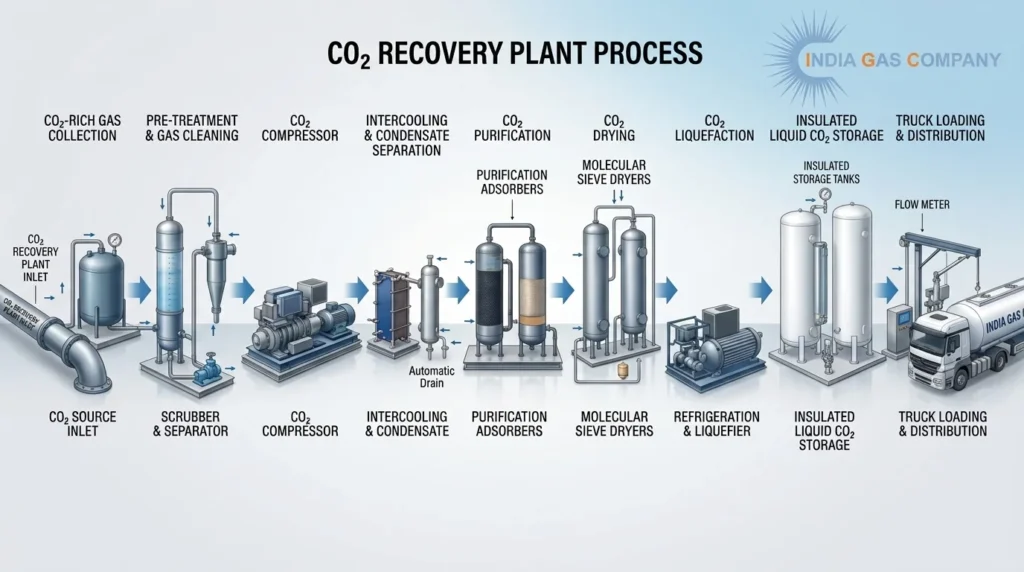
The process used in a CO2 recovery plant depends on the source gas and the required final product. However, a typical industrial configuration follows a sequence of gas collection, treatment, compression, purification, drying, liquefaction, and storage.
1. CO₂-Rich Gas Collection
The first stage is collecting the available gas from the source process.
Before designing the plant, engineers generally evaluate parameters such as:
- CO₂ concentration
- Gas flow rate
- Gas pressure
- Gas temperature
- Moisture content
- Oxygen concentration
- Nitrogen concentration
- Hydrocarbon content
- Sulphur compounds
- Other contaminants
- Available operating hours
- Variations in gas composition
This analysis is essential because the composition of the source gas determines the purification technology and equipment required.
A recovery system designed without properly understanding the feed gas can result in inadequate purification, excessive operating costs, or unreliable operation.
2. Pre-Treatment and Gas Cleaning
The incoming gas may contain contaminants that need to be removed before compression and further processing.
Depending on the source, pre-treatment may involve filtration, separation, scrubbing, cooling, or other gas-cleaning technologies.
The objective is to protect downstream equipment and reduce the contaminant load entering the purification section.
3. CO₂ Compression
Compression is one of the key stages of the process.
The recovered gas enters a compressor system where its pressure is increased in controlled stages. Industrial CO₂ compressors may be configured with multiple stages, intercooling, separators, and associated protection systems.
The compressor selection depends on:
- Gas flow
- Inlet pressure
- Required discharge pressure
- Gas composition
- Operating hours
- Capacity requirements
- Compression ratio
- Final application
Proper compressor sizing is important because both undersizing and oversizing can negatively affect plant performance.
4. Intercooling and Condensate Separation
Compression increases gas temperature. Therefore, intercooling is normally incorporated between compression stages.
Cooling helps reduce gas temperature and can cause moisture or condensable components to separate. These condensates can then be removed using appropriate separators.
This stage helps protect downstream purification and drying equipment.
5. Purification
Purification is critical when the recovered CO₂ is intended for applications that require controlled product quality.
The purification section can be configured according to the contaminants present in the feed gas. Depending on the application, the process may involve combinations of:
- Scrubbing
- Adsorption
- Filtration
- Separation
- Activated carbon treatment
- Deodorisation
- Removal of hydrocarbons
- Removal of sulphur compounds
- Oxygen reduction
- Other specialised purification stages
The exact purification technology should never be selected solely on the basis of CO₂ concentration. The entire contaminant profile must be considered.
6. Drying
Moisture is another important parameter in CO₂ processing.
Water can cause operational problems, particularly during compression, cooling, and liquefaction. Therefore, a CO₂ drying system is incorporated to reduce moisture to the required level.
A suitable CO2 recovery system should maintain stable moisture control under normal operating conditions and foreseeable variations in feed gas quality.
7. Liquefaction
If the end product is liquid CO₂, the purified and dried gas must be cooled and liquefied under controlled pressure and temperature conditions.
The refrigeration and liquefaction section is therefore a major part of a liquid CO₂ plant.
The design must account for:
- Required production capacity
- Refrigeration load
- Operating pressure
- Condensation conditions
- Product purity
- Ambient conditions
- Storage requirements
8. Liquid CO₂ Storage
Once CO₂ has been liquefied, it can be transferred to insulated storage tanks.
The storage capacity depends on production volume, customer demand, dispatch frequency, plant operating pattern, and logistics.
A storage system can include:
- Liquid CO₂ storage tank
- Pressure control system
- Level measurement
- Safety valves
- Pressure relief devices
- Instrumentation
- Transfer pumps
- Filling connections
9. Loading and Distribution
The final product can be transferred into road tankers or other suitable transportation systems, depending on the business model and customer requirements.
For captive consumption, liquid CO₂ may instead be transferred directly to the customer’s process.
Major Equipment Used in a CO2 Recovery Plant
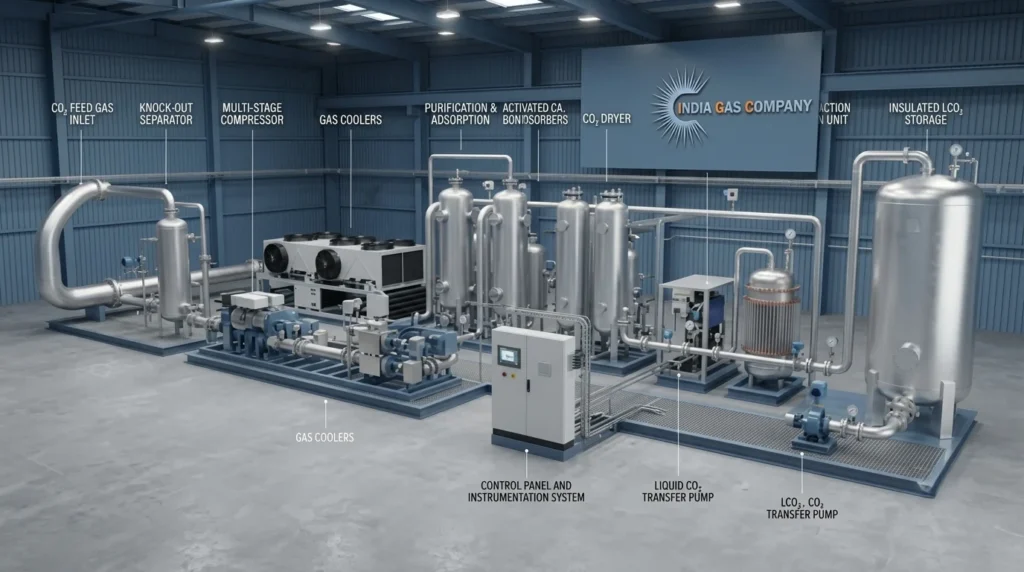
The equipment configuration differs from project to project. A typical industrial plant may include the following major equipment.
CO₂ Feed Gas System
This system collects the gas from the source and transfers it to the recovery plant.
It can include piping, valves, filters, knock-out vessels, separators, instrumentation, and gas monitoring equipment.
CO₂ Compressor
The compressor increases the pressure of the recovered gas.
Compressor selection should be based on the actual gas composition and operating envelope rather than simply selecting a compressor based on nominal flow.
Gas Coolers and Intercoolers
These systems remove heat generated during compression and help condense moisture and other condensable components.
Purification System
The purification section removes contaminants to achieve the required product specification.
The equipment selected depends heavily on feed-gas quality.
CO₂ Dryer
The dryer removes moisture from the gas stream before the gas enters the final processing stage.
Activated Carbon or Adsorption System
Where required, adsorption-based equipment can be used to remove specific contaminants.
Refrigeration System
The refrigeration package provides the cooling necessary for CO₂ liquefaction.
CO₂ Liquefier
The liquefaction system converts purified gaseous CO₂ into liquid CO₂ under controlled operating conditions.
Storage Tank
The liquid CO₂ storage tank provides buffer capacity between production and dispatch or consumption.
Pumps
Liquid CO₂ transfer pumps may be used for product movement, loading, or process transfer depending on the configuration.
Control System
Modern plants typically use instrumentation and automation to monitor critical parameters such as:
- Pressure
- Temperature
- Flow
- Level
- Gas composition
- Compressor conditions
- Refrigeration conditions
- Safety alarms
A properly integrated control system helps operators maintain stable plant operation.
Safety Systems
CO₂ is colourless and odourless and can present an asphyxiation hazard at elevated concentrations. Therefore, industrial CO₂ facilities require appropriate ventilation, gas detection, pressure relief, emergency systems, access controls, and operating procedures.
Safety engineering should be incorporated into the plant from the initial design stage rather than added after installation.
Factors That Affect CO2 Recovery Plant Cost
One of the first questions asked by a prospective project owner is: How much does a CO2 recovery plant cost?
There is no single standard price because the cost can vary substantially between projects.
A meaningful project estimate requires technical information about the feed gas, required production capacity, product purity, storage capacity, site conditions, utilities, automation level, and installation scope.
The major factors influencing CO2 recovery plant cost include the following.
1. Plant Capacity
Capacity is one of the largest cost drivers.
A small captive-use plant may require significantly less equipment than a large commercial CO₂ production facility.
Capacity is usually evaluated in terms of CO₂ production per hour, day, or year.
2. CO₂ Concentration in Feed Gas
Higher CO₂ concentration may simplify certain parts of the recovery process.
Low-concentration gas streams can require additional separation and treatment, potentially increasing both capital and operating costs.
3. Feed Gas Contaminants
The contaminant profile can significantly influence equipment selection.
If the feed contains higher levels of hydrocarbons, sulphur compounds, moisture, oxygen, or other impurities, additional treatment may be required.
4. Required Product Purity
Industrial-grade CO₂ and applications requiring stricter specifications may require different levels of purification and quality control.
The higher the specification, the more carefully the purification system must be engineered.
5. Liquefaction Requirement
A plant producing gaseous CO₂ can have a different configuration from a plant producing liquid CO₂.
Liquefaction requires refrigeration and associated equipment, which affects capital investment and power consumption.
6. Storage Capacity
Storage requirements depend on whether CO₂ is consumed continuously or dispatched to external customers.
Higher storage capacity generally means larger tanks, additional instrumentation, and increased project cost.
7. Automation Level
Manual, semi-automatic, and highly automated plants have different equipment and control-system requirements.
The right level of automation should be selected based on plant capacity, operating philosophy, manpower availability, safety requirements, and business objectives.
8. Site Conditions
Existing infrastructure can significantly affect the project budget.
Important factors include:
- Available land
- Foundation requirements
- Electrical supply
- Cooling water
- Instrument air
- Utility availability
- Existing process connections
- Piping distance
- Civil works
- Plant accessibility
9. Installation and Commissioning
Equipment supply is only one component of the project.
Engineering, transportation, erection, piping, electrical installation, instrumentation, commissioning, operator training, and documentation may also form part of the project scope.
For this reason, comparing suppliers purely on equipment price can produce misleading results.
How to Estimate the Cost of a CO2 Recovery Plant
A practical cost estimation exercise should begin with a technical feasibility study.
The project team should establish:
Feed gas → CO₂ concentration → gas flow → contaminants → required purity → production capacity → storage requirement → utilities → site conditions → final product application
Once these parameters are available, the engineering team can develop a preliminary process design and equipment list.
A detailed quotation may then include:
- Process engineering
- Mechanical equipment
- CO₂ compressor
- Purification equipment
- Dryer
- Refrigeration system
- Liquefaction equipment
- Storage tank
- Pumps
- Piping
- Valves
- Electrical systems
- Instrumentation
- PLC/SCADA
- Civil requirements
- Installation
- Commissioning
- Performance testing
- Operator training
- Documentation
This approach provides a more realistic understanding of the total project investment.
CO2 Recovery System vs CO2 Production Plant
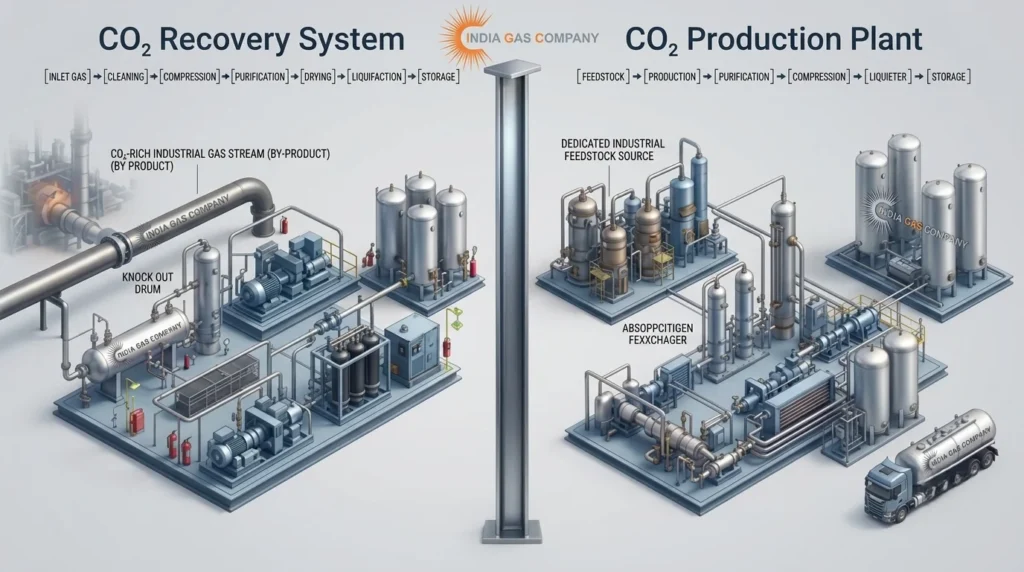
The terms CO2 recovery system and CO₂ production plant are sometimes used interchangeably, but technically they can refer to different concepts.
A recovery plant generally obtains CO₂ from an existing industrial gas stream where CO₂ is already being generated.
A CO₂ production plant may refer to a facility designed around a dedicated source or process for generating and producing CO₂.
For example, a company with an existing CO₂-rich fermentation gas stream may evaluate a recovery project. Another company may have a different raw material or process from which CO₂ needs to be produced.
The appropriate solution depends on the available feedstock and process conditions.
This distinction is important because it prevents a company from selecting a standard plant configuration without first understanding its actual source of CO₂.
Applications of Recovered CO₂
Recovered CO₂ has a wide range of potential applications.
Food and Beverage Industry
Carbon dioxide is widely used in food and beverage applications, including carbonation and controlled-atmosphere applications.
Where food-grade CO₂ is required, the recovery and purification system must be designed to achieve the applicable product-quality requirements.
Beverage Carbonation
Soft drinks, carbonated beverages, and other products can require significant quantities of CO₂.
A reliable internal source can be attractive for large beverage manufacturing facilities where suitable CO₂ is available.
Food Freezing
CO₂ can be used in refrigeration and freezing applications, including dry ice and cryogenic cooling processes.
Dry Ice Production
Liquid CO₂ can be used as a feedstock for dry ice manufacturing.
Dry ice is used in:
- Food transportation
- Cold-chain logistics
- Events
- Special effects
- Industrial cleaning
- Pharmaceutical logistics
- Temperature-sensitive transportation
Dry Ice Blasting
CO₂ pellets can be used for non-abrasive cleaning of machinery, moulds, electrical equipment, production lines, and industrial components.
Welding and Metal Fabrication
CO₂ and CO₂-containing shielding gas mixtures are used in welding applications.
Water Treatment
CO₂ can be used in selected water-treatment processes for pH adjustment and related applications.
Chemical Industry
CO₂ serves as a raw material or processing gas in several chemical applications.
Greenhouses
Controlled CO₂ enrichment can be used in greenhouse agriculture to support plant growth under appropriate conditions.
Refrigeration
Liquid CO₂ and solid CO₂ can be used in specialised cooling applications.
The suitability of recovered CO₂ for each application depends on product purity, customer specifications, regulatory requirements, and the characteristics of the recovered gas.
Food-Grade CO₂ Recovery: What Makes It Different?
Not every recovered CO₂ stream can automatically be classified as food-grade CO₂.
This is an important consideration for companies planning to supply CO₂ to food and beverage customers.
The source gas, purification technology, equipment materials, process controls, contamination risks, testing procedures, and quality management system must all be considered.
A food-grade project therefore requires more than simply increasing CO₂ concentration.
The plant should be engineered around the required product specification, and suitable quality testing and documentation should form part of the overall project approach.
For companies targeting the food and beverage market, it is advisable to determine the required specification before finalising the plant design.
CO2 Recovery Plant Design Considerations
Designing a recovery facility requires coordination between process engineering, mechanical engineering, electrical engineering, instrumentation, safety engineering, and site execution.
Some of the most important design considerations include:
Feed Gas Analysis
A proper laboratory analysis of the feed gas provides the foundation for equipment selection.
Capacity Calculation
The plant should be sized around actual and future production requirements rather than only current consumption.
Product Specification
The required purity should be defined before selecting purification equipment.
Utility Availability
Power, cooling water, instrument air, and other utilities should be evaluated during feasibility.
Plant Layout
Equipment should be positioned to allow safe operation, maintenance access, inspection, and future expansion.
Safety
CO₂ detection, ventilation, pressure protection, emergency shutdown, and operating procedures should be considered during design.
Maintenance
Critical components should be accessible for inspection and maintenance without requiring unnecessary plant shutdowns.
Future Expansion
If production is expected to increase, the initial design can consider future capacity expansion where commercially justified.
Why Integrated Engineering Matters in a CO2 Recovery Project?
A CO₂ facility is not simply a collection of individual machines.
The compressor must work with the purification system. The purification system must be compatible with the feed gas. The dryer must achieve the required moisture specification. The refrigeration system must support liquefaction. The storage system must match production and dispatch requirements.
This is why an integrated project approach can be more effective than purchasing unrelated equipment from different suppliers and attempting to integrate the systems later.
An experienced project partner can evaluate the entire process from feed gas to final product.
Choosing a CO2 Plant Manufacturer
Selecting a CO2 recovery plant supplier should involve more than comparing quotations.
A project owner should evaluate the supplier’s:
- Engineering capability
- Manufacturing capability
- Project experience
- Process understanding
- Equipment quality
- Automation expertise
- Installation support
- Commissioning capability
- After-sales support
- Spare-parts availability
- Documentation standards
- Safety approach
- Understanding of the customer’s application
The supplier should also be willing to understand the source gas before recommending a particular technology.
Why Project Experience Matters?
CO₂ plants involve multiple disciplines. Experience with one component does not necessarily mean experience with complete project execution.
An experienced engineering team understands how equipment selection affects:
- Energy consumption
- Product purity
- Plant reliability
- Maintenance
- Operating cost
- Safety
- Future expansion
This project-level perspective can make a significant difference to the long-term performance of the facility.
India Gas Company: Engineering Experience for CO₂ Projects
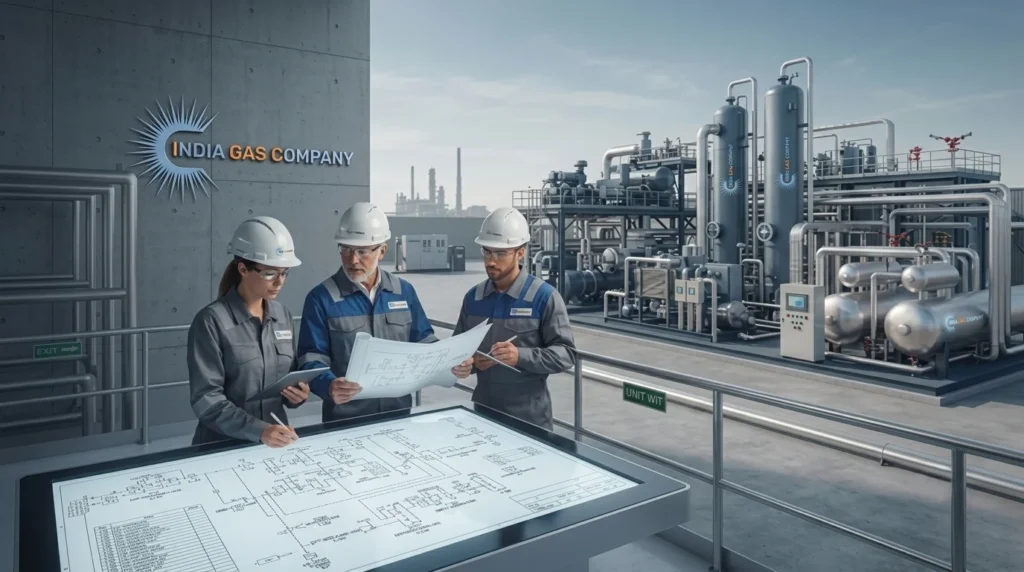
For companies evaluating a CO₂ recovery project, the selection of a project partner is an important decision.
India Gas Company brings more than 23 years of industry experience and has completed 100+ projects across industrial gas and related plant solutions.
The company’s role can extend across different stages of a project, depending on the customer’s requirements, including:
- Project consultation
- Technical feasibility
- Process design
- Equipment selection
- Plant engineering
- Equipment manufacturing
- System integration
- Installation support
- Commissioning
- Performance evaluation
- Operational guidance
- After-sales support
The advantage of working with an experienced project partner is that the plant can be developed around the customer’s actual requirements rather than forcing every project into a standard configuration.
For example, two companies may both require a CO₂ plant with similar nominal capacities, but their feed gas compositions, utilities, product requirements, site layouts, storage needs, and operating schedules may be completely different.
The engineering approach should therefore be customised accordingly.
India Gas Company’s experience across more than 100 completed projects provides a practical foundation for evaluating these project-specific requirements.
What Information Is Required Before Getting a CO₂ Plant Proposal?
Companies planning a CO2 recovery plant should ideally prepare the following information before approaching a plant manufacturer.
Feed Gas Details
Provide:
- Gas source
- CO₂ percentage
- Gas flow rate
- Gas pressure
- Gas temperature
- Moisture
- Oxygen
- Nitrogen
- Hydrocarbons
- Sulphur compounds
- Other known contaminants
Production Requirement
Specify:
- Required CO₂ production
- Hours of operation per day
- Days of operation per year
- Captive consumption
- External sales requirement
Product Requirement
Define whether the final product will be:
- Gaseous CO₂
- Liquid CO₂
- Dry ice
- Industrial-grade CO₂
- Food-grade CO₂
- Other specialised product
Storage Requirement
Mention the required storage capacity and expected dispatch frequency.
Site Information
The manufacturer may need:
- Available land
- Plant location
- Electrical power availability
- Cooling-water availability
- Existing infrastructure
- Installation conditions
- Site layout
The more accurate the initial data, the more reliable the technical proposal and commercial estimate will be.
How Long Does a CO2 Recovery Project Take?
Project timelines vary depending on plant capacity, technology, equipment scope, customisation, site conditions, statutory requirements, and installation requirements.
A typical project may include the following stages:
Feasibility → Engineering → Design Approval → Manufacturing → Factory Testing → Site Installation → Piping & Electrical Work → Commissioning → Performance Testing
Projects involving larger capacities or extensive site modifications naturally require more planning and execution time.
It is therefore better to establish a project-specific schedule after the technical scope has been finalised rather than relying on a generic timeline.
Operating Cost of a CO2 Recovery Plant
Capital investment is only one part of the financial analysis.
A project owner should also evaluate the ongoing operating cost.
Major operating expenses can include:
- Electricity
- Cooling utilities
- Refrigeration power
- Compressor operation
- Maintenance
- Consumables
- Replacement filters
- Adsorbent or purification media
- Labour
- Water, where applicable
- Testing and quality control
Energy efficiency should therefore be considered during equipment selection.
A slightly higher initial investment in efficient equipment can sometimes provide better economics over the operating life of the plant.
The correct evaluation should consider total cost of ownership, rather than only the initial equipment price.
ROI and Payback Considerations
The commercial viability of a CO₂ project depends on several factors.
A basic evaluation can consider:
Annual CO₂ production × Net value of recovered CO₂ = Potential annual value
From this figure, the project owner can evaluate operating expenses and capital investment.
Other factors include:
- Current CO₂ purchase price
- Transportation cost
- Existing CO₂ consumption
- Surplus CO₂ available
- Product selling price
- Plant utilisation
- Electricity cost
- Maintenance cost
- Storage requirement
- Financing cost
The actual payback period should be calculated using project-specific numbers.
For a company purchasing large quantities of CO₂, avoiding external purchases may represent one part of the financial benefit. For a company with surplus CO₂, external sales may create another revenue opportunity.
Common Mistakes to Avoid When Setting Up a CO₂ Recovery Plant
Mistake 1: Designing the Plant Without Feed-Gas Analysis
Feed-gas composition determines the purification requirements. Designing without reliable analysis can lead to incorrect equipment selection.
Mistake 2: Comparing Suppliers Only on Price
The cheapest quotation may not necessarily deliver the lowest lifecycle cost. Equipment efficiency, reliability, maintenance, product quality, and after-sales support should also be evaluated.
Mistake 3: Ignoring Product Purity
If the intended application requires high-purity CO₂, this should be established before the purification system is designed.
Mistake 4: Underestimating Storage
Production and consumption may not always occur at exactly the same rate. Appropriate storage can provide operational flexibility.
Mistake 5: Ignoring Future Expansion
If the company expects production or CO₂ demand to grow, the initial plant layout should be evaluated for expansion possibilities.
Mistake 6: Treating Safety as an Afterthought
CO₂ safety should be integrated into the plant design from the beginning.
Mistake 7: Looking Only at Capital Cost
Power consumption, maintenance, consumables, and downtime can significantly affect the long-term economics of the project.
Is a CO2 Recovery Plant Suitable for Your Industry?
A recovery project can be worth evaluating if your facility:
- Produces a CO₂-rich gas stream
- Consumes substantial quantities of CO₂
- Currently purchases CO₂ from external suppliers
- Has regular CO₂ demand
- Generates surplus CO₂
- Wants to explore CO₂ monetisation
- Requires greater supply independence
- Is considering liquid CO₂ production
- Is evaluating dry ice production
- Wants to improve utilisation of an industrial by-product
However, suitability cannot be determined from industry type alone.
The feed gas composition and flow rate are critical.
A technical feasibility assessment can determine whether recovery is practical and what type of CO2 recovery system would be appropriate.
Frequently Asked Questions About CO2 Recovery Plants
Q1. What is a CO2 recovery plant?
A CO₂ recovery plant captures carbon dioxide from a suitable industrial gas stream, purifies it, dries it, compresses it, and, where required, liquefies it for storage and use.
Q2. What is the difference between CO2 recovery and CO2 capture?
CO₂ capture is generally associated with separating CO₂ from a gas stream. CO₂ recovery usually refers to collecting and processing CO₂ into a usable product. The exact terminology can vary depending on the industrial application.
Q3. Can recovered CO₂ be converted into liquid CO₂?
Yes. Where the gas is suitable and the process is appropriately designed, purified CO₂ can be compressed, cooled, and liquefied.
Q4. Can recovered CO₂ be used for dry ice?
Yes. Suitable liquid CO₂ can be used as feedstock for dry ice production, provided the product meets the requirements of the intended application.
Q5. What determines CO₂ plant capacity?
Capacity depends on available feed gas, CO₂ concentration, gas flow rate, operating hours, recovery efficiency, product requirements, and the desired output.
Q6. How much does a CO2 recovery plant cost?
There is no universal price. Cost depends on capacity, feed-gas composition, purification requirements, liquefaction technology, storage capacity, automation, site conditions, utilities, installation, and commissioning.
A project-specific technical and commercial assessment is required for an accurate estimate.
Q7. Can a CO₂ recovery plant produce food-grade CO₂?
Potentially, yes, but the system must be specifically engineered to achieve the required quality specifications. Feed-gas quality and purification requirements are critical.
Q8. What industries can use recovered CO₂?
Potential applications include food and beverages, beverage carbonation, dry ice, industrial cleaning, welding, water treatment, chemical processing, refrigeration, greenhouses, and other industrial applications.
Q9. Does a CO₂ recovery plant require regular maintenance?
Yes. Compressors, refrigeration equipment, valves, instrumentation, purification equipment, dryers, pumps, and safety systems require scheduled inspection and maintenance.
Q10. How do I select the right CO2 recovery system?
Start with feed-gas analysis, gas flow, required CO₂ output, product purity, end-use application, storage requirements, utilities, and site conditions. A qualified plant manufacturer can then develop the appropriate process configuration.
Conclusion
A CO2 recovery plant can transform an available CO₂-rich gas stream into a valuable industrial resource. For companies that currently purchase CO₂, generate surplus CO₂, or operate a process that produces a suitable CO₂-rich stream, recovery can provide an opportunity to improve resource utilisation and strengthen supply security.
However, successful implementation depends on much more than installing a compressor and storage tank.
The feed gas must be analysed correctly. Purification must be designed around actual contaminants. Compression must be properly sized. Drying must meet the required specification. Liquefaction must be engineered for the intended operating conditions. Storage must match production and dispatch requirements. Safety systems must be incorporated from the beginning.
The right question is therefore not simply “How much does a CO₂ plant cost?”
The better question is:
“What CO₂ recovery configuration will deliver the required product quality, capacity, reliability, and operating economics for our specific application?”
A detailed feasibility study and engineering evaluation can answer that question and provide a practical foundation for investment, execution, and long-term operation.


2 thoughts on “CO2 Recovery Plant: Process, Equipment, Cost & Applications”